


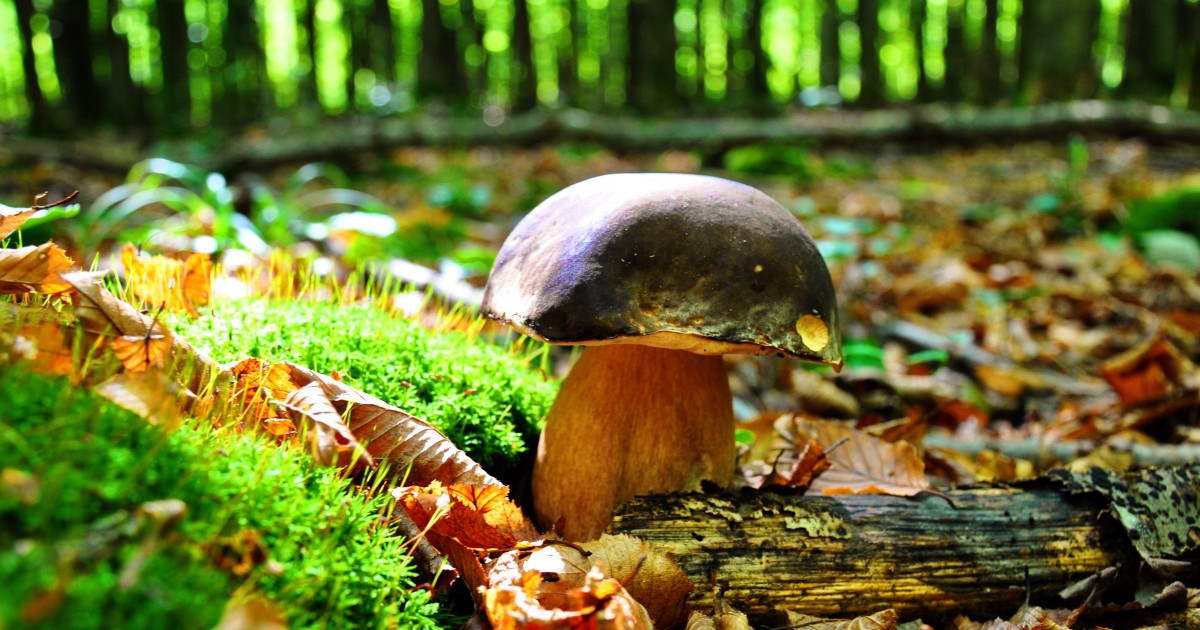

Few experiences bring quite the same thrill as spotting a porcini mushroom hidden among the fallen leaves of a woodland floor. Boletus edulis and its close relatives are a highly sought-after prize for millions of enthusiasts who head out at dawn each year.
But where can you pick porcini mushrooms in Italy? Across the country, there are particular seasons and local regulations to understand before entering the woods.
Porcini mushroom season
There is no fixed date in the calendar, as fruiting depends on the conditions: moderate rainfall rather than heavy downpours, woodland-floor temperatures between 15°C and 22°C, and good levels of moisture in the soil.
Generally, the porcini mushroom season in Italy runs between June and November, though dates differ considerably according to altitude and latitude. The summer cep, Boletus aestivalis, is usually the first to appear, as early as late May or June in warm, south-facing areas below 700 metres.
The black cep, Boletus aereus, also thrives in warm conditions and follows shortly afterwards in oak woods across hilly areas during the hottest months.
The real surge comes in autumn. During the second half of September and throughout October, when nights become cooler but daytime temperatures remain mild, Boletus edulis appears in beech, chestnut and conifer woods.
The pine cep, Boletus pinophilus, which is associated with mountain pine and fir forests, can extend the season into the first days of November in the cool, damp parts of the Apennines and Alps.
Where to find porcini mushrooms
Porcini grow in symbiosis with the roots of particular trees, including chestnuts, beeches, oaks, firs and pines, and cannot be cultivated. Finding them means learning to spot clearings at the edge of denser vegetation, north-facing slopes where moisture lingers longer, and acidic soil that is high in humus.
Here are six destinations that every enthusiast should know.
Borgo Val di Taro
The Italian capital of porcini mushrooms is undoubtedly Borgo Val di Taro, in the province of Parma. It is home to the Fungo di Borgotaro PGI, the only fresh porcini mushroom in Europe to hold Protected Geographical Indication status.
The PGI production area includes the municipalities of Albareto, Bedonia, Berceto, Compiano and Tornolo, as well as Borgo Val di Taro itself on the Emilia side of the Apennines, and Pontremoli and Zeri on the Tuscan side.
The woods are typical of the Tuscan-Emilian Apennines: coppiced beech and chestnut woodland managed using traditional methods that naturally support biodiversity and porcini growth, at altitudes ranging between 500 and 1,700 metres.
Picking generally takes place between June and October and is regulated by the Union of Municipalities of the Taro and Ceno Valleys, which issues specific permits. Every autumn, the Fungo di Borgotaro PGI Fair features street food, cooking demonstrations and tastings, attracting enthusiasts from across Italy.
Val Brembana
In the province of Bergamo, Val Brembana has earned a reputation as Lombardy’s mushroom-picking paradise. With plentiful water, springs, dense woods and high-altitude pastureland, the valley provides suitable habitat for a surprising range of species.
The places most frequented by experienced foragers are concentrated in the upper valley: Branzi, Foppolo, Piazzatorre, Carona, Mezzoldo, Valtorta, Oltre il Colle, Dossena and the well-known Val Taleggio.
The Val Brembana Mountain Community regulates mushroom picking in around 28 municipalities. Some require a permit, while others allow collection without one, subject to the daily limit.
A major local event is Fungolandia, the Alto Brembo festival that takes place each September, with guided excursions, a competition for the largest mushroom, markets and themed menus in local restaurants.
Casentino
In the Casentino Forests, Monte Falterona and Campigna National Park, porcini grow abundantly beneath beech, chestnut and silver fir trees, at elevations between 800 and 1,200 metres. The summer season begins after July rainfall, but autumn brings the most satisfying finds, when the temperature difference between day and night becomes pronounced, and the forest floor remains damp.
Picking within the national park is possible, but it is subject to specific regulations, including permits and limits that differ from those applied at regional level.
Monte Amiata
Further south in Tuscany, Monte Amiata is an ancient extinct volcano dominating the area between the provinces of Siena and Grosseto. Its slopes are covered in beech, chestnut and Norway spruce woods above 900 metres, and are among the region’s most productive places for porcini hunting.
Collection rules follow the regulations of the Tuscany Region. A regional permit is required, while residents can pick free of charge within their own municipality. The daily limit is 3 kg. Picking is permitted from one hour before sunrise until one hour after sunset, and only ventilated baskets may be used.
Every autumn, the local municipalities of Abbadia San Salvatore, Castel del Piano, Arcidosso and Santa Fiora host Amiatautunno, where porcini take centre stage in the food programme.
Irpinia
In Campania, the Irpinia area of the province of Avellino has woods that can be surprisingly generous for mushroom foragers. Irpinia has a mountain microclimate that is unusual for southern Italy, with cold winters, cool summers at altitude and plentiful autumn rain.
Two areas stand out. The Partenio Regional Park, across the provinces of Avellino, Benevento and Caserta, has mixed chestnut, beech and oak woods where porcini are found mainly between September and November. Trails beginning in Irpinian villages such as Ospedaletto d’Alpinolo and Mercogliano are among the most popular.
Another key destination is the Laceno Plateau, within the municipality of Bagnoli Irpino. In Campania, a mushroom-picking permit is compulsory and is issued only after passing a qualifying exam on identifying mushroom species.
Pollino
At the southern end of the Apennines, straddling Basilicata and Calabria, Pollino National Park is Italy’s largest natural park. It is also one of southern Italy’s most underrated destinations for porcini hunting.
The areas around Castelluccio Inferiore, Castelluccio Superiore, Rotonda and Viggianello are referred to by enthusiasts as the kingdom of porcini, thanks to humidity and temperature conditions that become especially favourable in autumn.
All four porcini species found in Italy grow here. The black cep and the summer cep are found in warmer, lower areas, while Boletus edulis and the pine cep prefer cool, shaded beech woods at higher altitudes.
As this is a national park, mushroom picking is subject to specific rules set by the park authority, which may differ from the usual regional regulations. It is essential to check in advance and obtain any required permits.
Can you pick mushrooms without a permit?
Italy does not have a single nationwide law governing mushroom picking. Rules are managed at the regional level, with sometimes significant differences between areas. In most cases, legal collection requires some form of authorisation. This may be a permit issued after a course, a simple payment, or both.
Fines for those found without permission start at €40–€50 and can exceed €200, with the immediate confiscation of the collected mushrooms. Some regions also apply additional penalties for every kilogram collected above the permitted limit.
Beyond the bureaucracy, there is one rule that applies everywhere: never pick a mushroom unless you can identify it with absolute certainty. Italy’s local health authorities, the ASL, provide a free mycological inspection service during the picking season.
Source: https://www.idealista.it/