



Italy is often associated with well-kept, lived-in villages, but there is another side to the country: places emptied of their residents and seemingly frozen on the day they were left behind. There are more than a thousand abandoned villages across Italy. Some are little more than piles of ruins reclaimed by vegetation, while others still contain furniture, tools and old shop signs.
Visiting a ghost town in Italy means stepping into a piece of the country’s social history, rather than simply finding an atmospheric photography spot.
Craco, Basilicata: the village frozen in 1963
Craco is probably southern Italy’s best-known ghost town. The village dates back to the 10th century and became a strategically important military stronghold during the reign of Frederick II. Life continued there until 1963, when landslides and ground instability forced residents to move elsewhere.
Today, this ghost village in Basilicata is a maze of stone houses, towers and churches perched precariously on a clay slope. Cinema brought it international attention, with scenes from Mel Gibson’s The Passion of the Christ and Quantum of Solace, part of the James Bond series, filmed here. Matera is the most convenient starting point, a short drive away or reachable on organised tours.
Apice Vecchia, Campania: the “Pompeii of the 20th century”
Apice Vecchia lies around 12 kilometres from Benevento and is considered by many to be Italy’s most atmospheric ghost village. Its “Pompeii of the 20th century” nickname comes from the way its lanes, shops and houses appear frozen in time. The village was abandoned after the earthquake of 21 August 1962, when the Ministry of Public Works ordered the evacuation of its roughly 6,500 residents.
Part of the population remained until 1980, when the Irpinia earthquake forced the last residents to leave. The village has been made safe, although visits require people to follow the authorised routes near the castle.
Monterano Antica, Lazio: ruins and a film location
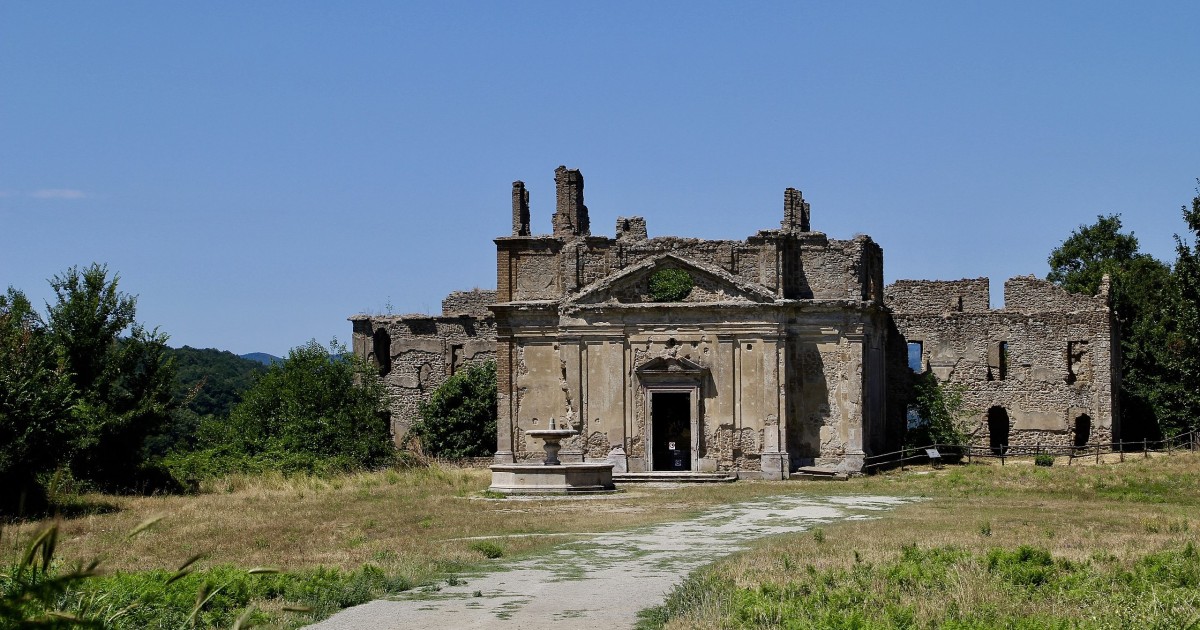
Monterano Antica is located in the municipality of Canale Monterano, just north of Lake Bracciano. The area was inhabited by the Etruscans and Romans before passing under papal control. It was abandoned at the end of the 18th century, following an invasion by French troops and a malaria outbreak.
Today, the site is a genuine open-air museum, with its medieval castle, the Convent of San Bonaventura, the Fontana Capricciosa and its lion statue, plus the remains of the cathedral. Its ruins have provided a backdrop for films including William Wyler’s Ben-Hur (1959), Brancaleone at the Crusades (1970) and The Marquis del Grillo (1980). The site lies within the Monterano Nature Reserve, where the walking route passes through pleasant woodland.
Noto Antica, Sicily: the city that was born twice
Noto Antica tells a particular story of abandonment, as it resulted from rebuilding rather than a slow decline. The earthquake of 1693 almost completely levelled the settlement, and the new town of Noto was built a few kilometres away. The original settlement remains as a medieval reminder, with the Porta della Montagna, the ruins of the medieval castle, and remnants of churches and noble palaces.
A visit here feels like a small open-air archaeological adventure. It can be paired with time in Baroque Noto and its surrounding area, showing how the collapse of one town gave rise to another.
Consonno, Lombardy: Olginate’s “toy town”
Consonno, a hamlet of Olginate in the province of Lecco, is a case apart. It was not abandoned because it was poor, but because it was turned into an amusement park that did not stand the test of time.
During the 1960s, a building entrepreneur transformed it into a kind of “Italian Las Vegas”, intended for parties, weekends and short breaks. In return for the Olginate town council approving the plan in 1961, he proposed building the access road.
The old village was replaced with restaurants, dance halls, a luxury hotel, a medieval-style castle and a shopping centre with a minaret, now its best-known structure.
Its decline was swift and was accelerated by a landslide, commonly dated to 1976, which cut off the only access road. Following an unsuccessful attempt to turn the site into a care home for older people, the place was left abandoned.
Pentedattilo, Calabria: the hand-shaped village
The name Pentedattilo comes from the Greek Penta Daktylos, meaning “five fingers”, and refers to the five rocky outcrops rising from Mount Calvario. Depopulation began after the earthquake of 1783 and ended in the second half of the 20th century, when the last resident left.
In 1686, the village was the scene of a bloody feud between noble families, the so-called “Alberti massacre”. This episode gave rise to ghost stories which, according to local folklore, still haunt the houses. The final stretch must be covered on foot, as the road becomes too narrow and steep.
Toiano, Tuscany, and Scoppio, Umbria: two hill villages
Toiano, in the province of Pisa, is a medieval village that has been uninhabited for around half a century. It was left behind because of limited job prospects and unstable ground, and it is still possible to glimpse furniture and household objects inside the houses. The viewpoint looks out towards Volterra and San Miniato.
Scoppio, in the province of Terni, in the Monti Martani, was abandoned in the 1950s after several earthquakes, when it was home to around 25 families. It retains the Romanesque Church of San Michele Arcangelo, dating to around the 11th century and still decorated with frescoes.
Can ghost villages be visited for free?
It depends on the location. Some villages, such as Monterano Antica, have free entry according to a travel guide, while others, including Craco, require a paid guided visit.
In other cases, access is free but unregulated, with risks connected to the stability of the buildings. Before visiting, it is worth checking the website of the relevant Comune (municipality) or managing body.
Stay inspired for your spooky adventures in Italy —get our weekly newsletter for the latest travel, legal, and lifestyle news.
Source: https://www.idealista.it/