


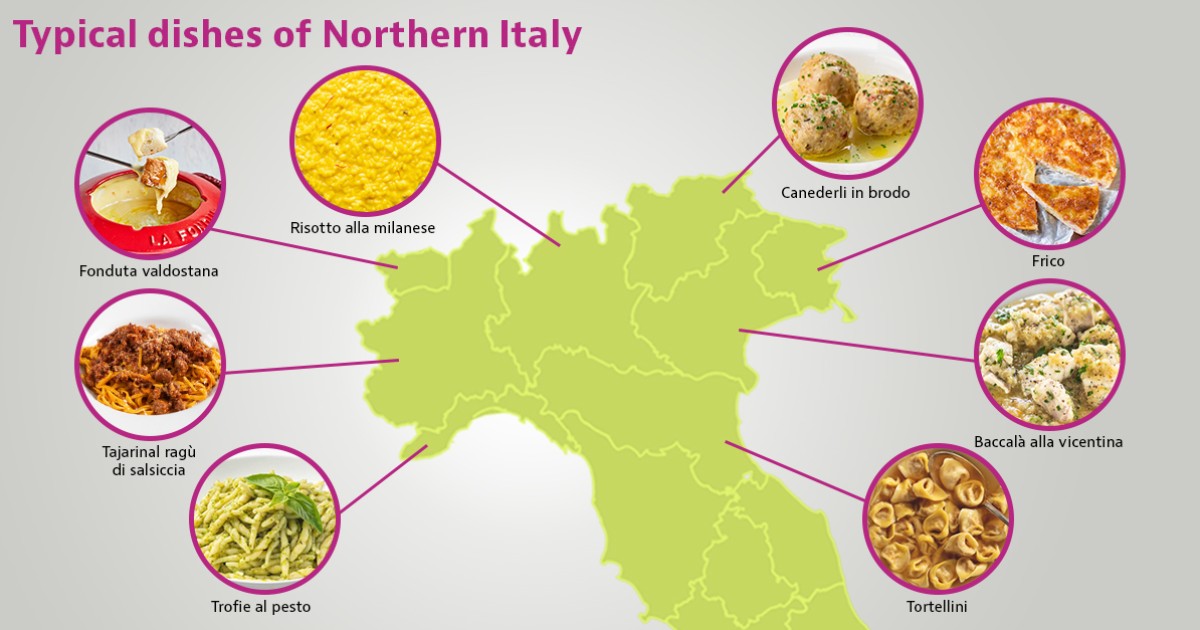

Northern Italian food changes considerably across its regions. Alpine cooking in Valle d’Aosta leans on mountain cheese, butter and warming dishes, while Liguria turns to basil and olive oil. In the Po Valley, rice, filled pasta and slow-cooked sauces take centre stage. The result is not one single “northern Italian cuisine”, but a collection of local traditions shaped by climate, farming and trade.
Many of the ingredients behind these regional dishes carry protected status, including Fontina DOP, Basilico Genovese DOP, Montasio DOP and Parmigiano Reggiano DOP. For visitors and new residents, these are eight traditional northern Italian dishes that make a useful introduction to eating well beyond the usual pizza-and-pasta shortlist.
Valle d’Aosta: fonduta valdostana
Fonduta valdostana is one of the best-known dishes from Valle d’Aosta, a small Alpine region bordering France and Switzerland. It is made with Fontina DOP, a full-bodied cow’s milk cheese produced exclusively in the valley.
The cheese is cut into cubes and usually left to soften in milk before being melted gently in a bain-marie. Butter and egg yolks are then worked through it to create a smooth, thick sauce.
It tends to arrive at the table hot, accompanied by toasted bread, polenta or, in some restaurants, a little shaved truffle.
Piedmont: tajarin al ragù di salsiccia
In the wine-growing hills of the Langhe and Roero in Piedmont, tajarin are a local point of pride. These exceptionally fine ribbons of egg pasta are made with a generous number of yolks, giving them their deep yellow colour and soft, silky texture.
One common way to serve them is with ragù di salsiccia, a sausage sauce made by browning crumbled sausage with onion, then cooking it gently with red wine and a modest amount of tomato.
Autumn brings another local version: tajarin with butter and shaved white truffle from Alba. The truffle is the main event, so the pasta is deliberately kept simple.
Liguria: trofie al pesto genovese
Pesto is one of Italy’s most widely exported sauces, though pesto alla genovese in its home region is rather more specific than the supermarket jar variety. A traditional version uses Basilico Genovese DOP, pine nuts, garlic, Ligurian extra-virgin olive oil, Parmigiano Reggiano, pecorino and coarse salt.
The name comes from the Italian verb pestare, meaning to crush. Traditionally, the ingredients are worked in a marble mortar with a wooden pestle rather than blitzed in a food processor. This keeps the basil fresh-tasting and prevents the leaves from overheating.
Trofie, small twisted strands of fresh pasta, are particularly associated with the Ligurian coast and are the usual pasta pairing. In the classic local version, the pasta is cooked with green beans and potato pieces, which make the sauce cling nicely and turn it into a more substantial lunch.
Lombardy: risotto alla milanese
Risotto alla milanese is Lombardy on a plate: rice, butter, stock, cheese and saffron, cooked with patience rather than rushed. Its warm golden colour comes from saffron, one of the dish’s defining ingredients.
The rice is toasted with butter and onion, splashed with white wine, then cooked gradually with hot stock. At the end, it is mantecato — vigorously finished with butter and Grana Padano or Parmigiano Reggiano to produce its characteristic creamy texture.
A popular story links the dish to a glassmaker working on the stained-glass windows of Milan Cathedral, who supposedly added saffron to a wedding rice dish after using it to produce golden tones in his craft.
Veneto: baccalà alla vicentina
There is a small linguistic curveball with baccalà alla vicentina. Although baccalà usually refers to salted cod in Italian, the Vicenza recipe traditionally uses stoccafisso — air-dried codfish — instead.
The dried fish is soaked for several days, then cooked slowly with onions, anchovies, parsley, olive oil and milk. Some recipes include Parmigiano Reggiano.
This dish is closely guarded in Vicenza by the Venerabile Confraternita del Bacalà alla Vicentina, an association dedicated to protecting the traditional recipe. It is also celebrated each year in Sandrigo, near Vicenza, during a festival centred on the dish.
Trentino-Alto Adige/Südtirol: canederli in brodo
Canederli, also called Knödel in German, are large bread dumplings common across Trentino-Alto Adige/Südtirol. They began as a practical way to use stale bread, a reminder that many much-loved Italian dishes started with a determination not to waste food.
The mixture commonly includes cubed bread, eggs, milk, flour, onion, parsley and diced speck, the lightly smoked cured ham associated with South Tyrol. Cheese, spinach or beetroot versions are also common, particularly in mountain huts and traditional restaurants.
The classic serving is canederli in brodo: dumplings in clear hot broth. They can also come dry, topped with melted butter and grated cheese, or alongside cabbage salad and sauerkraut.
Friuli Venezia Giulia: frico
Frico is a filling dish from Friuli Venezia Giulia, made with Montasio DOP, a cheese produced in the region and parts of neighbouring Veneto. Its origins lie in cucina povera, the practical home cooking that turned leftover ingredients into proper meals.
There are two main versions.
- The crisp version is essentially cheese cooked in a pan until it becomes a thin, golden wafer.
- The softer version combines cheese with potato and onion, creating a thick, melting round with a crisp outside and soft middle.
It is usually served hot and cut into wedges, often with polenta.
Emilia-Romagna: tortellini in brodo
Tortellini are closely tied to Bologna and Modena, two cities with a long-running and very affectionate rivalry over their culinary heritage. These tiny rings of egg pasta are filled with a mix that traditionally includes pork loin, prosciutto crudo, mortadella, Parmigiano Reggiano, egg and nutmeg.
The classic way to eat them is tortellini in brodo, served in a clear meat broth, often made with capon, beef and other meats. It is a fixture of Christmas lunch in many Emilian homes. The Dotta Confraternita del Tortellino deposited an official recipe with the Bologna Chamber of Commerce in 1974, a sign of just how seriously this little pasta is taken.
Tortellini also appear with butter and sage, cream or meat sauce, though the broth version is the one most closely associated with the region.
Stay in the know about living in Italy as a foreigner—get our weekly newsletter for the latest travel, legal, and lifestyle news.
Source: https://www.idealista.it/