


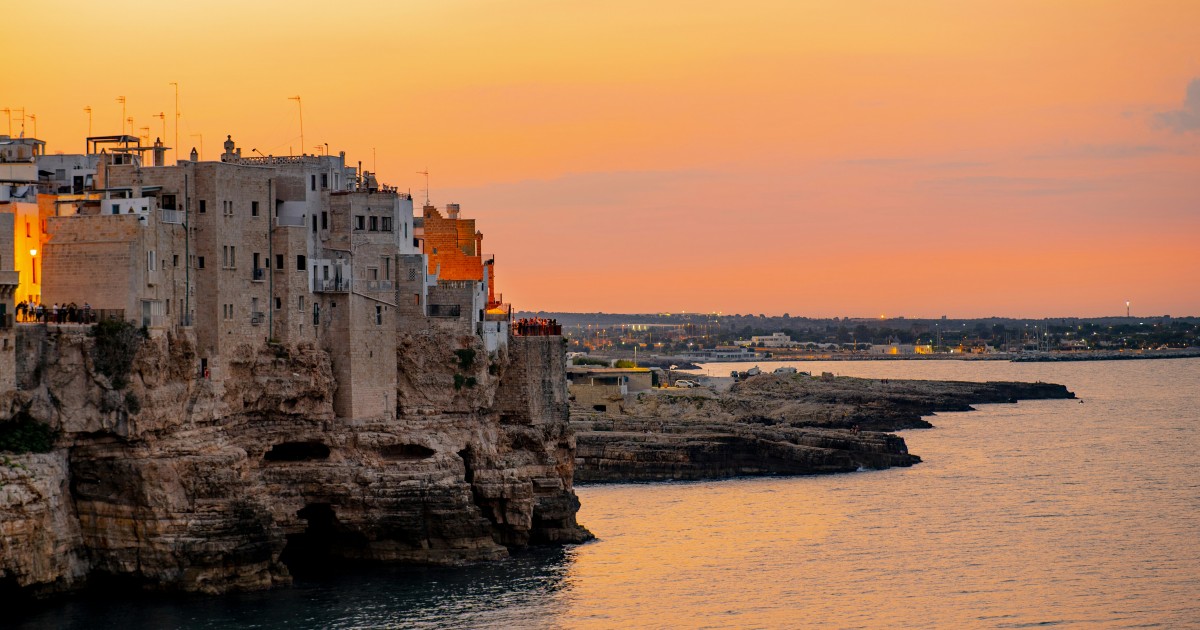

Puglia is a serious alternative to Tuscany, the Amalfi Coast and northern Italy’s pricier cities. Italy’s heel has white-stone towns, trulli, olive groves and two coastlines, alongside a property market that remains comparatively accessible.
Living in Puglia, Italy, suits buyers, remote workers, retirees and families looking for sunshine, beach access and a slower daily rhythm. The compromises are real: Italian is vital for getting things done, public transport is limited beyond the main towns, and popular coastal spots change markedly in summer.
Is Puglia a good place to live?
Puglia can work very well for people who prioritise local community life, warm weather and homes that do not consume the whole budget.
Bari, Lecce, the Valle d’Itria and Salento cover very different versions of the region, from city living to rural countryside and coastal towns.
What life in Puglia is really like
Life in Puglia shifts noticeably depending on where you settle. Bari, the regional capital, has the broadest range of day-to-day services, as well as a university, port and airport.
Further south, Lecce has a more compact feel. Its baroque streets, student population and year-round cafés and shops give it a sense of momentum beyond the summer season.
Inland, places such as Cisternino, Martina Franca and Alberobello move at a gentler pace, with local markets, family-run businesses and a stronger small-town rhythm.
Summer brings long, hot days and late evenings in the piazza. Beaches and coastal towns get busy, particularly in August, when many Italian families take their annual holiday, and some smaller businesses operate reduced hours.
Cost of living in Puglia
The cost of living in Puglia is generally lower than in Milan, Rome, Florence and much of Tuscany, although it varies widely between larger cities, inland towns and the better-known coastal hotspots.
Based on Numbeo figures for Bari and Lecce, a meal at an inexpensive restaurant costs around €15, while dinner for two at a mid-range restaurant comes to roughly €60. A beer out is about €3.50, and a cappuccino or coffee at a café averages €1.75. These prices are not fixed across the region, but local bars and trattorie in smaller towns can be a little easier on the wallet.
Utilities are another figure worth factoring in, especially in older properties. Basic household bills for an 85 m² flat, including electricity, heating, cooling, water and rubbish collection, average around €180 per month in Bari and Lecce.
Property prices in the Puglia region
Housing is still the central expense. According to August 2026 idealista figures, the average asking price across Puglia is €1,310 per m², while average rents stand at €9.0 per m².
- At those averages, a 70 m² property would cost about €91,700 to buy or around €630 per month to rent, before purchase costs, utilities and any renovation budget.
Explore property for sale across Puglia
Best places to live in Puglia
Bari: city life, services and direct connections
Bari is a practical base for people who need hospitals, schools, shops, public transport and frequent airport access. It has a busy old town, a ferry port and direct rail links to other Italian cities.
Murat, Madonnella and San Pasquale are central neighbourhoods that are often more convenient for daily life than the historic core.
- Property prices in Bari average €2,207 per m², so a 70 m² home would therefore cost around €154,490 before purchase costs.
- Rent prices in Bari average €12.5 per m², or about €875 per month for 70 m².
Bari makes sense for people who need reliable services and year-round activity. Traffic, noise and denser housing are part of the bargain.
Lecce: a year-round base in Salento
Lecce combines ornate baroque streets with a university population, useful amenities and a lived-in centre. It is inland, but both the Adriatic and Ionian coasts are within driving distance.
- Property prices in Lecce average €1,610 per m², putting a 70 m² home at approximately €112,700. It is less expensive than Bari and Puglia’s prime coastal towns while retaining the conveniences often missing in smaller places.
Lecce is a good fit for people who want Salento without the seasonality of a resort. A car is helpful for beach trips and getting around the wider peninsula.
Ostuni: characterful but expensive
Ostuni, La Città Bianca, sits on a hill above the Adriatic. It is well located for beaches, the Valle d’Itria and Brindisi Airport, but its popularity with second-home owners has pushed values up.
- Property prices in Ostuni average €2,557 per m², or around €178,990 for a 70 m² apartment.
- Ostuni Costa is pricier, with some of the highest prices in Puglia.
Ostuni may suit a part-time base or a permanent move focused on historic-town life, provided winter services, parking and house condition have been properly assessed.
Monopoli and Polignano a Mare: sought-after coastal life
Monopoli has a working harbour, historic streets and local services alongside beaches. It also sits on the rail line between Bari and Brindisi. Nearby Polignano a Mare is a cliffside coastal town with high visitor demand and a higher property premium.
These spotsin Puglia are growing in popularity within Italy’s luxury property market.
- Property prices in Monopoli average €2,659 per m², putting a 70 m² home at roughly €186,130.
- In Polignano a Mare, prices average €2,919 per m², or about €204,330 for 70 m².
Living in Valle d’Itria: small towns and country homes
The Valle d’Itria runs through parts of the Bari, Brindisi and Taranto provinces. Martina Franca, Locorotondo, Cisternino and Alberobello are surrounded by olive groves, dry-stone walls and trulli.
It suits people after rural surroundings without complete isolation, though a car is essential. A typical trullo can be a lovely home, but its thick stone walls and heritage restrictions may make renovation more involved.
Living in Salento: coast and village life
Salento stretches south of Lecce between the Adriatic and Ionian seas. Gallipoli, Otranto, Nardò, Galatina and Maglie each provide a different balance of coast, local services and village life.
The peninsula feels more removed than the Bari area, which is either part of its appeal or a limitation. Travel to airports, specialist healthcare and large shops takes longer, particularly in the far south.
Healthcare, schools and practical services
Italy’s public health service, the Servizio Sanitario Nazionale (SSN), is regionally run. Eligible residents register with their local ASL health authority and choose a family doctor where places are available.
Puglia’s principal hospital services are concentrated in Bari and Lecce. Non-urgent specialist appointments may involve waits, leading some residents to use private clinics for specific needs.
State schools teach in Italian. International options are more limited than in Rome, Milan and Florence, with Bari providing the widest choice of education and support services in the region. For families in smaller towns, language learning and local integration become particularly important.
Getting around and Puglia airports for expats
Bari Airport is the region’s main international airport and generally has the widest selection of routes. Brindisi–Salento Airport is more convenient for Ostuni, Lecce and Salento. Flight schedules vary by season.
Bari is the best-connected city by train, with high-speed services towards Rome, Naples and Milan. Regional trains serve much of the Adriatic coast, but coverage becomes patchier inland and farther south.
Historic centres frequently have restricted-traffic zones, or ZTL, and driving into one without permission can lead to a fine.
Puglia weather year-round, beaches and daily life
Puglia’s climate is one of the main draws for people considering a move, particularly for anyone used to northern European winters.
- Summers are long, dry and properly hot, with July and August bringing the most intense temperatures inland and across Salento.
- Winter is generally mild, but that does not always translate into a warm home. Older stone houses can be chilly and damp indoors if they have poor insulation, inefficient heating or limited ventilation.
Puglia has two very different coastlines to enjoy. The Adriatic side is dotted with rocky coves, limestone cliffs and town beaches, while the Ionian coast in Salento has longer stretches of soft sand and shallow water. Both become busy in high summer, particularly around Ferragosto in mid-August.
Puglia compared with Tuscany, Sicily and Abruzzo
|
Puglia |
Coastal towns, southern cities, olive-growing countryside and village life |
€1,310 per m² in August 2026 |
Bari and Brindisi airports; strongest rail links around Bari |
Heat, seasonal tourism and car dependence outside the main towns |
|
Tuscany |
Hill towns, historic cities, countryside and a large international community |
€2,633 per m² in August 2026 |
Strong rail links and airports around Florence and Pisa |
Higher purchase prices and significant visitor pressure in popular areas |
|
Sicily |
Island living, large cities, beaches and strong local identities |
€1,103 per m² in August 2026 |
Several airports, though travel to mainland Italy takes more planning |
Greater distances, variable local services and very hot summers |
|
Abruzzo |
Mountains, Adriatic coast, national parks and smaller towns |
€1,252 per m² in August 2026 |
Good road connections, but fewer international routes |
Colder winters, a smaller international scene and less reliable public transport beyond larger towns |
Living in Tuscany, Sicily and Abruzzo each suit different priorities. Puglia is particularly compelling for people seeking coastal access, southern Italian food culture and a lower purchase-price entry point than Tuscany’s most sought-after locations.
Pros and cons of living in Puglia
The upsides of living in Puglia
- Housing can be attainable: Puglia’s regional average remains below many headline Italian destinations.
- Two coasts: the Adriatic and Ionian seas are easy to reach across much of the region.
- Everyday food culture: local produce, seafood, pasta, bread and olive oil are central to the weekly shop.
- Useful airport access: Bari and Brindisi make travel to the UK and elsewhere in Europe more manageable.
The compromises of living in Puglia
- Italian is essential: especially for administration, healthcare, property and services outside tourist areas.
- Hot summers: cooling a home and adapting daily routines are important.
- Car dependence: rural and small-town life is difficult without one.
- Seasonality: popular beach towns can be crowded in summer and subdued in winter.
Stay in the know about living in Italy as a foreigner—get our weekly newsletter for the latest travel, legal, and lifestyle news.
Source: https://www.idealista.it/