


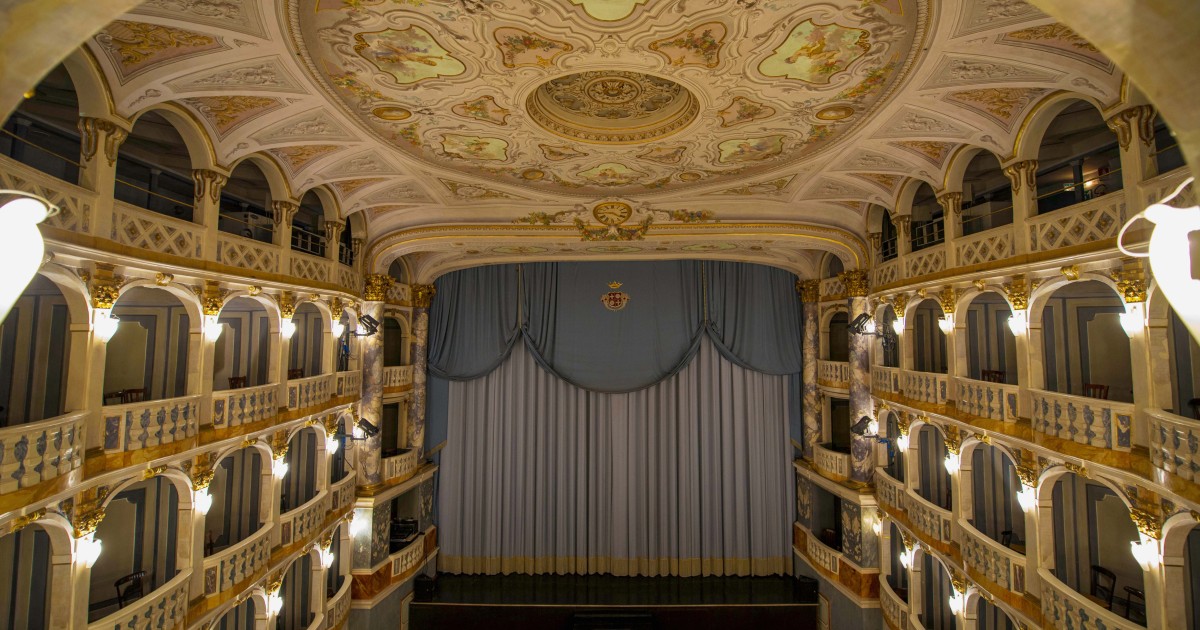

There is a corner of Italy where theatre was never a luxury reserved for a few, but a collective project funded by the community. Across historic towns and provincial cities in Marche, Umbria and Emilia-Romagna, ten historic theatres tell an extraordinary story. Between the 18th and 19th centuries, families, nobles and institutions joined forces, rather like a condominium association, to build cultural spaces open to all.
On 26 July 2026, this group of theatres was added to the UNESCO World Heritage List. Italy now has 62 UNESCO sites, retaining its position at the top of the global ranking.
But what exactly are UNESCO condominium theatres, and where can they be found and visited?
- What ‘condominium’ theatres are: central Italy’s ingenious idea
- Where the UNESCO condominium theatres are: regions and towns
- Teatro Angelo Mariani, Sant’Agata Feltria, Emilia-Romagna
- Teatro Gentile da Fabriano, Fabriano, Marche
- Teatro Giovanni Battista Pergolesi, Jesi, Marche
- Teatro Ventidio Basso, Ascoli Piceno, Marche
- Teatro Serpente Aureo, Offida, Marche
- Teatro dell’Aquila, Fermo, Marche
- Teatro Lauro Rossi, Macerata, Marche
- Teatro Feronia, San Severino Marche, Marche
- Teatro Bramante, Urbania, Marche
- Teatro Nuovo Gian Carlo Menotti, Spoleto, Umbria
What ‘condominium’ theatres are: central Italy’s ingenious idea
The word condominiale has nothing to do with modern residential apartment blocks. It refers instead to a funding and management model that developed between the 18th and 19th centuries.
Groups of noble families and well-off citizens formed a society of co-owners to buy theatre boxes and meet the costs of constructing a theatre. In return, each participant became the owner of a box, which could be inherited or transferred to someone else.
With the Italian-style condominium theatre model, even small and medium-sized towns in central Italy could build elegant theatres, complete with horseshoe-shaped auditoriums, tiers of decorated boxes, sophisticated stage machinery and foyers designed for public gatherings. UNESCO’s recognition rests on the combination of three elements: refined architecture, an ongoing cultural role and civic participation.
Where the UNESCO condominium theatres are: regions and towns
The UNESCO-listed serial site comprises ten buildings across three regions: eight in Marche, one in Umbria and one in Emilia-Romagna.
According to the Italian National Commission for UNESCO, Marche has the world’s highest concentration of Italian-style condominium theatres, making the region the focal point of the whole network.
Teatro Angelo Mariani, Sant’Agata Feltria, Emilia-Romagna
Among the hills of Montefeltro, in the only theatre of the ten located in Emilia-Romagna, stands one of Italian theatre architecture’s great masterpieces. Teatro Angelo Mariani is considered Italy’s oldest theatre built entirely from wood. Constructed in the 17th century inside the Palazzone, commissioned by Marquis Orazio Fregoso, it was turned into a permanent theatre during the 18th century.
Built in chestnut wood, from the stalls to the stage, it takes its name from Maestro Angelo Mariani, the conductor appointed at a very young age to lead Sant’Agata Feltria’s Accademia Filarmonica.
Teatro Gentile da Fabriano, Fabriano, Marche
Teatro Gentile in Fabriano has a story of beauty and resilience. The first theatre, called Teatro dell’Aurora, opened in 1692 and was designed by Venetian architect Pietro Mauro. The current building is the result of two later reconstructions, the last completed in 1852, when architect Vincenzo Ghinelli enlarged the auditorium to 91 boxes spread across four tiers.
Damaged in the 1997 earthquake, the theatre was later restored and returned to the people of Fabriano. It has since resumed its role as one of the area’s main cultural venues. Its name honours the celebrated painter Gentile da Fabriano, one of the city’s most distinguished sons.
Teatro Giovanni Battista Pergolesi, Jesi, Marche
Teatro Pergolesi in Jesi is perhaps the clearest example of the pure condominium model. It opened in 1798 as Teatro della Concordia, created on the initiative of Jesi’s patrician class, who joined together as co-owners to fund its construction. Francesco Maria Ciaraffoni designed the project, later revised by the celebrated architect Cosimo Morelli. The result was an elliptical auditorium decorated with mythological frescoes by painter Felice Giani.
The building was only renamed in 1883, in honour of the city’s distinguished son Giovanni Battista Pergolesi, a composer recognised around the world. In 1968, it became the first theatre in Marche to receive the title of Teatro di Tradizione, a highly prestigious designation for a town that is not even a provincial capital.
Teatro Ventidio Basso, Ascoli Piceno, Marche
Built between 1840 and 1846 on the remains of the old Church of San Francesco alle Grazie, Teatro Ventidio Basso, one of the places to see in Ascoli Piceno, is the largest historic auditorium in the province. It has 842 seats across the stalls, four tiers of boxes and the upper gallery. The original design was by architect Ireneo Aleandri, then reworked by Marco Massimi, Gabriele Gabrielli and Giambattista Carducci.
It opened on 27 March 1846 with Giuseppe Verdi’s I Lombardi alla prima crociata. The theatre is named after Publius Ventidius Bassus, a Roman military commander from Ascoli Piceno.
Teatro Serpente Aureo, Offida, Marche
Offida, considered one of Marche’s loveliest historic towns, holds a small theatrical treasure: Teatro Serpente Aureo. It was created inside the town hall and is reached through the municipal portico, without its own façade. Its current shape dates to a 19th-century reconstruction completed in 1846 and refined in 1862 to a design by Pietro Maggi.
Its 50 gilded boxes, horseshoe plan and ceiling frescoed with Apollo and the Muses have earned it the affectionate nickname “the Piceno jewel box”. The curtain, painted in 1926, tells the story of the golden serpent that gives both the theatre and the town’s coat of arms their name.
Teatro dell’Aquila, Fermo, Marche
With 124 boxes arranged across five tiers, Teatro dell’Aquila in Fermo is one of Marche’s most imposing historic theatres. Work began in 1780 on designs by Cosimo Morelli, replacing the old wooden theatre in Palazzo dei Priori, which had been destroyed by fire. It opened in 1790 and has room for around 1,000 spectators.
One of its most fascinating details is the still-working 19th-century stage machinery, a rare reminder of the technical complexity behind historic productions. The ceiling is decorated with a fresco by Luigi Cochetti, dedicated to the gods of Olympus.
Teatro Lauro Rossi, Macerata, Marche
Teatro Lauro Rossi is Marche’s only surviving example of an Italian-style theatre with a wooden structure finished to resemble marble. It was commissioned in 1765 by a group of 46 nobles from Macerata and designed by the renowned stage designer Antonio Galli, known as Bibiena, before later being adapted by Cosimo Morelli. It opened in 1774 and was renamed in 1884 after the Macerata composer Lauro Rossi.
Today, it shares the city with the Sferisterio, the monumental open-air amphitheatre that hosts the Macerata Opera Festival. They are two complementary sides of the city’s lively theatrical tradition.
Teatro Feronia, San Severino Marche, Marche
Established in 1747 as Teatro dei Condomini, Teatro Feronia was rebuilt in masonry in 1823 to a design by Ireneo Aleandri, after the previous wooden structure was deemed unsafe. It took its current name in 1828, in honour of the goddess Feronia, to whom an ancient temple in the Potenza valley was dedicated.
The auditorium’s decorations, including its historic curtain, were created by painters Filippo Bigioli and Raffaele Fogliardi. One feature that catches visitors’ attention is its origin. Like other buildings in the UNESCO group, the theatre was created within the spaces of an existing structure.
Teatro Bramante, Urbania, Marche
At the heart of Urbania, a town that proudly claims its connection with Donato Bramante, Teatro Bramante stands on the site of a 14th-century fortress that belonged to the Brancaleoni counts.
The Accademia degli Acerbi first refurbished it in 1726, based on designs by Pietro Abati. It was then completely rebuilt in the mid-19th century to plans by Ercole Salmi, opening in 1864 with Verdi’s Il Trovatore. Its compact proportions and intimate atmosphere make it one of the most evocative condominium theatres in the group.
Teatro Nuovo Gian Carlo Menotti, Spoleto, Umbria
The site’s only Umbrian theatre is also its best known internationally. Designed by architect Ireneo Aleandri between 1854 and 1864, Teatro Nuovo di Spoleto has the classic horseshoe-shaped layout, with four tiers of boxes and an upper gallery.
For almost 70 years, it has been the main venue for the Festival dei Due Mondi, the internationally recognised cultural festival founded by Gian Carlo Menotti in 1958. With this recognition, Spoleto gains its second UNESCO site, alongside the Basilica of San Salvatore, already listed as part of The Longobards in Italy.
Stay inspired for your adventures in Italy —get our weekly newsletter for the latest travel, legal, and lifestyle news.
Source: https://www.idealista.it/