


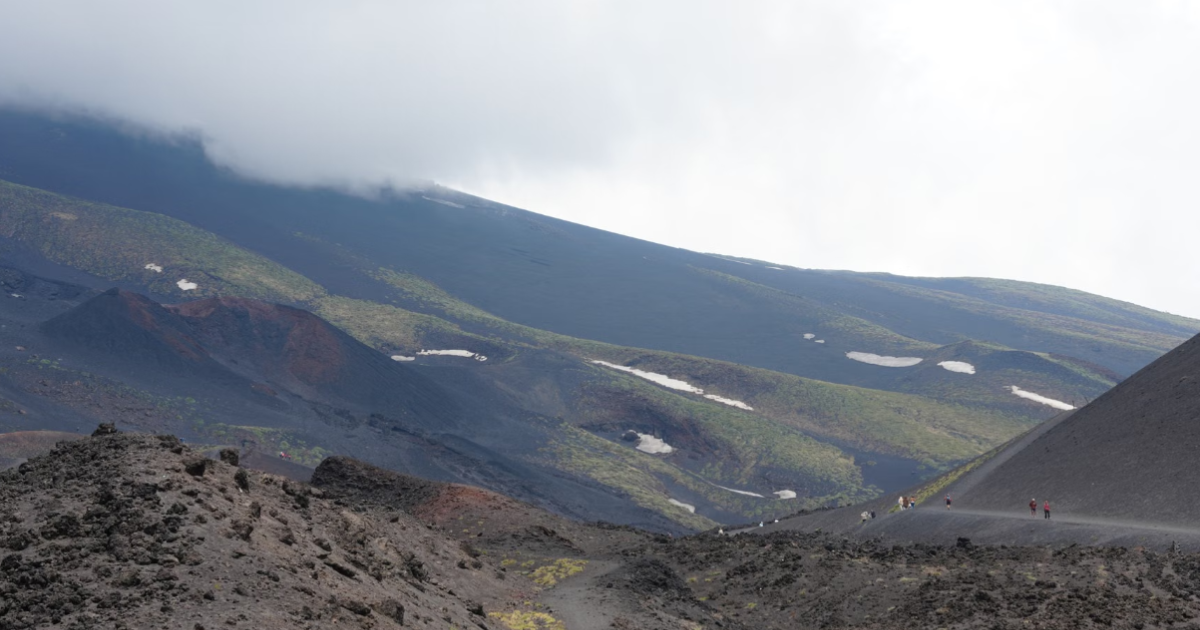

The sight of Mount Etna sending out plumes is a reminder of how alive Italy’s underground world remains. The figures are even more striking: across the mainland and islands, there are around 70 volcanoes, many of which can be reached on foot. Not all, however, are within hiking distance. Some lie at inaccessible depths, while others appeared and disappeared within a matter of weeks, leaving behind disputes and legends.
Here is an overview of Italy’s volcanoes, including where to go, how to get around and the safety points worth keeping in mind.
A country shaped by fire: an essential overview
Across the mainland and its archipelagos, Italy has around 70 volcanoes, each with a different story: active craters, extinct cones and calderas opening out like natural amphitheatres.
What may come as a surprise is that many of these places are accessible on foot. A few hours of walking can take you across solid lava flows and fields of fine ash.
This closeness calls for care and respect, but it also gives people a rare chance to observe geological formations up close that, elsewhere in the world, can remain distant or closely restricted.
Mount Etna, the giant that sets the pace
In recent times, Sicily’s volcano has shown clear signs of activity, with emissions making headlines. Mount Etna sets the timetable for anyone planning an ascent. Access changes according to conditions and the regulations in force, so it is always sensible to check current information before planning a climb.
Walking here means seeing overlapping layers of lava, discovering glassy surfaces and crossing dark expanses broken up by pioneer plants. The setting changes quickly: the wind can carry ash and make the air feel sharp, while colours shift across deep black and rusty red.
Beneath the sea: the invisible giants Marsili and Vavilov
Not all Italian volcanoes can be reached. Marsili and Vavilov, for instance, lie at depths that make them impossible to approach. They are underwater mountains that add a quiet chapter to the story of the Tyrrhenian Sea, shaping the seabed far beyond view. These invisible giants are a reminder that Italy’s volcanic system extends much further than the coastline suggests.
The presence of submerged volcanoes explains some of the complexity of Italian geology. Even when they do not break the surface, they influence the structure of the basin and help explain the dynamics linking the islands and coastlines.
The island that disappeared: the case of Ferdinandea
Off the coast of Sciacca, a short-lived island emerged for several weeks, prompting European governments to compete for control over it. The land then sank back beneath the sea, leaving only maps, stories and a name still in circulation: Ferdinandea.
Its story shows how much Mediterranean geography remains in motion, and how fragile human claims can look in the face of a geological event.
Safety and access: the rules
Climbing a volcano means accepting a clear order of priorities: access rules and protection of the area come before the route anyone might have in mind.
Official channels should be checked, the support of authorised guides considered, and marked paths respected. Clothing also needs proper thought, as sharp ground and sudden winds leave little room for carelessness.
Article originally seen in ilsole24ore.com: Su e giù per i vulcani italiani in compagnia di reminiscenze letterarie
Source: https://www.idealista.it/