



Some places leave an impression before the curtain has even risen. They are buildings where architecture, history and music come together in something unforgettable: spaces designed to lift the spirit and stay in the memory.
The great opera houses are living monuments to human culture, holding legendary premières and bearing witness to centuries of artistic life. Europe, the Americas, Australia and Asia each have at least one theatre that could contend for the title of the world’s most important.
But which are the 10 most important theatres in the world? Here are some of the finest spaces created to celebrate music.
- Teatro Colón, Buenos Aires, Argentina
- Teatro alla Scala, Milan
- Teatro Massimo, Palermo
- Opéra Garnier, Paris, France
- Vienna State Opera, Vienna, Austria
- Royal Opera House, London, United Kingdom
- Gran Teatro La Fenice, Venice
- Metropolitan Opera House, New York, United States
- Hungarian State Opera House, Budapest, Hungary
- Sydney Opera House, Sydney, Australia
Teatro Colón, Buenos Aires, Argentina
Opened in 1908 after almost 20 years of construction, Buenos Aires’ Teatro Colón is considered by many experts to be the world’s most important opera house. Designed by Italian architect Francesco Tamburini, the building covers around 8,200 m² and stands close to Avenida 9 de Julio, one of the widest avenues in the world. Its acoustics are widely regarded as among the best anywhere, comparable only with those of Paris’s Opéra Garnier.
Its stage has welcomed composers and conductors of exceptional stature, including Arturo Toscanini, Richard Strauss, Igor Stravinsky and Karl Böhm. The horseshoe-shaped main auditorium can seat around 2,487 people across the stalls and galleries. Teatro Colón remains a singular case: a European masterpiece in the heart of South America, symbolising the era when Buenos Aires aspired to be the Paris of the new continent.
Teatro alla Scala, Milan
No list of the world’s most important theatres would be complete without Milan’s Teatro alla Scala, the unquestioned home of Italian opera and one of the world’s most prestigious cultural venues. Built at the request of Empress Maria Theresa of Austria and designed by architect Giuseppe Piermarini, it opened on 3 August 1778 with Antonio Salieri’s L’Europa riconosciuta.
On the evening of Santo Stefano in 1883, it became the first theatre in the world to be lit by electricity, when 2,450 bulbs powered by the Edison station turned the stage into a spectacle in its own right.
Since its foundation, La Scala has been a showcase for Italian operatic talent. Rossini, Bellini, Donizetti and Verdi staged some of their most celebrated works here. The chorus, orchestra, ballet company and, since 1982, the Filarmonica della Scala are also based in the building, securing its position among the world’s leading theatres. With around 2,030 seats, La Scala remains a key reference point for opera worldwide.
Teatro Massimo, Palermo
Palermo’s Teatro Massimo is Italy’s largest theatre building and one of Europe’s largest, with a total floor area of more than 7,700 m². Located in Piazza Giuseppe Verdi, it opened in 1897 after more than 20 years of work led by architect Giovan Battista Filippo Basile, followed by his son Ernesto.
Its neoclassical structure was considered so significant that, during the Second World War, Allied Command included it on its list of monuments to be protected from bombing.
The main auditorium is horseshoe-shaped, with five levels of boxes and capacity for around 1,358 people. Above the stalls is the Ruota Simbolica, or “Symbolic Wheel”: 11 petal-shaped, frescoed wooden panels depicting the Triumph of Music. Teatro Massimo’s acoustics are considered exceptional, thanks to a design that turns architecture into pure musical resonance.
Opéra Garnier, Paris, France
The Opéra Garnier, also called the Palais Garnier, may be the theatre most firmly rooted in the public imagination, not least through Gaston Leroux’s The Phantom of the Opera. Built between 1861 and 1875 to designs by architect Charles Garnier, it stands in Paris’s 9th arrondissement and is listed as a French historic monument.
Construction was interrupted several times after workers discovered numerous underground water channels, resulting in an artificial lake beneath the building, said to be the size of two Olympic swimming pools.
Its style is pure Second Empire, with lavish decoration, marble friezes, mosaics and Marc Chagall’s paintings on the ceiling of the main auditorium, paying tribute to 14 composers from music history. The large stage can hold up to 450 performers at once, while the auditorium has around 1,900 seats. Opéra Garnier is also home to the Paris Opera Ballet School, the oldest and most prestigious classical ballet school in the world.
Vienna State Opera, Vienna, Austria
The Vienna State Opera, or Wiener Staatsoper, is one of Austria’s capital’s defining landmarks and has the world’s broadest international opera repertory. It opened on 25 May 1869 in the presence of Emperor Franz Joseph I and Empress Elisabeth of Bavaria, better known as Sisi.
Architects August Sicard von Sicardsburg and Eduard van der Nüll designed the building. Van der Nüll did not live long enough to receive the recognition he deserved, taking his own life a few months before the opening after being crushed by criticism that likened the theatre to a railway station.
Almost completely destroyed in the 1945 bombings, the opera house was faithfully rebuilt and reopened in 1955, becoming a symbol of Austria’s post-war cultural renewal. Each season, the Vienna State Opera presents more than 50 different opera and ballet productions, with a repertoire unlike any other in the world.
Royal Opera House, London, United Kingdom
London’s Royal Opera House sits at the heart of British opera and ballet. The history of the current venue begins in 1732, but two earlier theatres on the same site were destroyed by major fires in 1808 and 1856. The current building, the third on the site, opened in 1858 and underwent a complete refurbishment in the late 1990s, reopening in 1999 with cutting-edge technical facilities.
Today, the Royal Opera House is home to the Royal Opera and the Royal Ballet, two of the world’s most highly regarded performing arts companies. The main auditorium has around 2,256 seats, arranged across several levels of boxes and galleries. The venue is also particularly appreciated for its foyer and adjoining spaces, which make it a cultural setting used beyond performance times and as part of everyday city life.
Gran Teatro La Fenice, Venice
Venice’s Gran Teatro La Fenice carries its most remarkable story in its name. Destroyed by fire twice, in 1836 and 1996, it rose from the ashes on each occasion, like the mythical bird after which it was named. First opened in 1792, it quickly became one of Europe’s most important theatres, hosting world premières of key 19th-century operas by Rossini, Bellini, Donizetti and Verdi.
The most recent 1996 fire, which was caused deliberately, almost completely destroyed the building and prompted an international wave of support. After years of work, La Fenice reopened in 2003, rebuilt com’era, dov’era — “as it was, where it was” — in faithful respect for its original architecture.
With capacity for around 1,000 people, it is not the world’s largest theatre, but it is undoubtedly one of the most loved. It sits within a singular setting: Venice’s canal-lined cityscape, accessible only on foot or by boat.
Metropolitan Opera House, New York, United States
New York’s Metropolitan Opera House, commonly called “the Met”, is the United States’ largest opera house and one of the world’s most influential. It is located at Lincoln Center in Manhattan, on Broadway. It first opened in 1883 in a building later destroyed by fire. The current venue was built between 1963 and 1966 and has capacity for around 3,800 people.
The Met’s stage has hosted some of opera’s greatest figures, including Enrico Caruso, Plácido Domingo, Maria Callas and Renée Fleming. Arturo Toscanini also made his debut there in 1908, confirming the theatre as an essential stage for anyone seeking to make their name in opera. The Met is now also associated with its live cinema broadcasts around the world, which have brought opera to millions of viewers internationally.
Hungarian State Opera House, Budapest, Hungary
The Magyar Állami Operaház, or Hungarian State Opera House, is one of Europe’s finest Baroque theatres and ranks third globally for acoustic quality. Designed by architect Miklós Ybl and opened in Budapest in 1884, it is among the Hungarian capital’s most imposing architectural works. T
The horseshoe-shaped main auditorium is decorated with frescoes, sculptures and symbols from Hungary’s musical tradition, including a statue of composer Ferenc Erkel, who wrote the Hungarian national anthem.
Every year, on the final Sunday of Carnival, the building becomes a grand ballroom, hosting the traditional Budapest Opera Ball since 1886, one of the most glamorous events on Europe’s cultural calendar. The theatre has been restored several times during the 20th century, while retaining its original atmosphere.
Sydney Opera House, Sydney, Australia
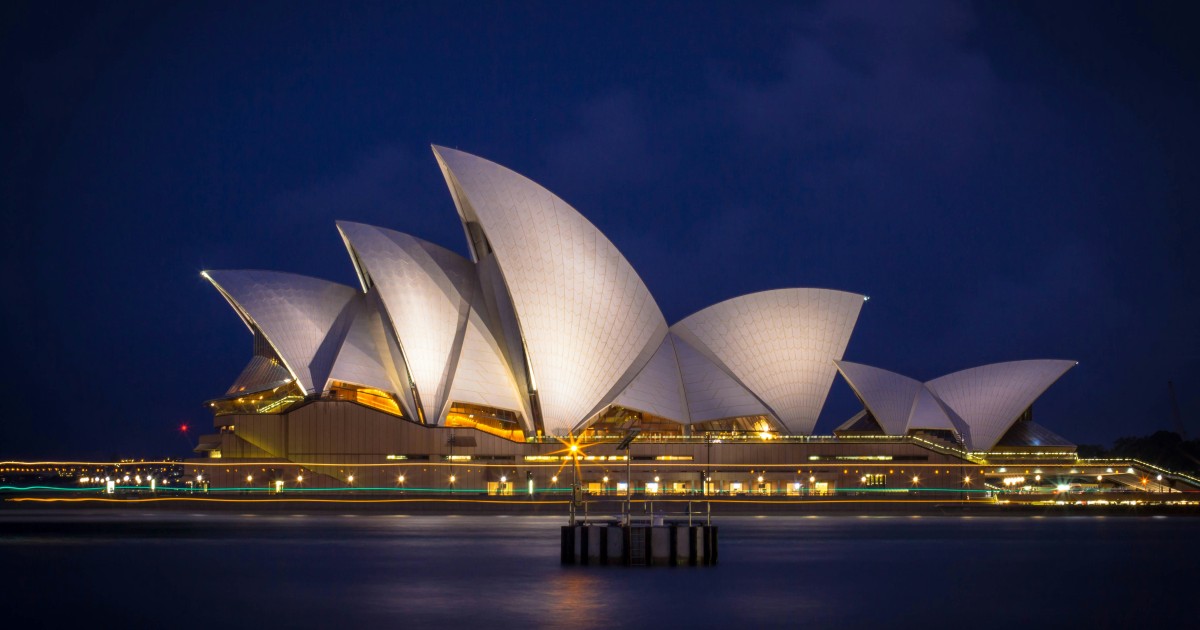
The Sydney Opera House may be the most iconic building of the 20th century. Its 16 white concrete “sails”, reflected in Sydney Harbour, have become a symbol not only of Australia but also of modern architecture worldwide.
Danish architect Jørn Utzon designed it after a controversial international selection process. Construction lasted between 1959 and 1973 and was marked by endless disputes. Utzon resigned before completion and never returned. It has been a UNESCO World Heritage Site since 2007.
Contrary to popular belief, the sail-like forms were not a tribute to the sea. Utzon later revealed that he had been inspired by sections of an orange, imagining that joined together they would form a perfect sphere.
Inside, the building holds the world’s largest mechanical organ, with 10,154 pipes. Its first informal performance took place in 1960, while the building was still under construction, when singer Paul Robeson climbed the scaffolding and sang Ol’ Man River to workers on their lunch break.
Stay inspired for your adventures in Italy —get our weekly newsletter for the latest travel, legal, and lifestyle news.
Source: https://www.idealista.it/