


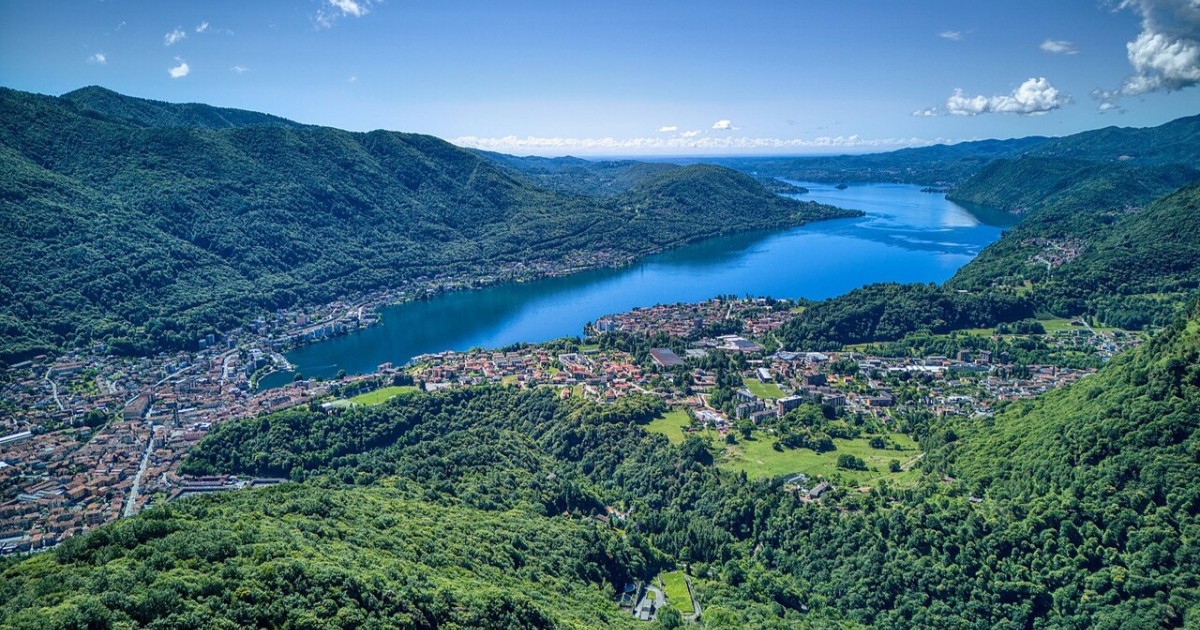

It looks like a volcanic lake, but it was shaped by ice. Lake Orta, west of Lake Maggiore, between the provinces of Novara and Verbano-Cusio-Ossola, packs an elegant waterside village, a tiny monastic island and a UNESCO-listed Sacro Monte into just a few kilometres.
Two days are enough on Lake Orta to combine scenery, art and a bit of peace and quiet without rushing, travelling on foot and by boat.
Orta San Giulio: a waterside piazza terrace
The heart of a visit is Orta San Giulio, on the eastern shore. This pedestrian-friendly village slopes down towards Piazza Motta, a genuine terrace over the water with direct views of the island. It has the feel of a compact, well-kept place where the smaller details matter: flower-filled balconies, internal courtyards and views that open up without warning.
At its centre stands the Palazzotto della Comunità, a 16th-century building and a symbol of local administrative history, set between the shore and the boat landing.
The uphill walk towards the parish church of Santa Maria Assunta passes through a network of old palazzi and stone lanes. Comfortable shoes and a careful step are useful, particularly in wet weather.
Piazza Motta and nearby: a slower pace and details worth noticing
Village life moves between lakeside tables and boats travelling back and forth. This is where the right weekend pace becomes clear: unhurried timing, a curious eye and short stops. Each alleyway changes the perspective, while every flight of steps reveals another fragment of local history.
Two days allow enough time to wander around the centre without haste, particularly in the morning before the busiest hours. The island boat landing is only a few steps away, as is the path that climbs towards the Sacro Monte.
Isola di San Giulio: basilica, abbey and the Way of Silence
Seen from the shore, the island appears close enough to touch. It measures only a few hundred metres in length and is almost entirely occupied by historic buildings, gardens and religious spaces. It is reached by boat, with services and frequencies changing according to the season. Outside the busiest tourist months, it is sensible to check the boat timetable in advance.
Once ashore, the Basilica di San Giulio is the island’s symbolic and spiritual centre, connected with the tradition of Saint Julius, who is credited with evangelising the area. Next door, the Mater Ecclesiae Benedictine abbey adds to the quiet, contemplative feel found across the island.
A short circular walk, the Via del Silenzio e della Meditazione or Way of Silence and Meditation, follows the accessible perimeter, passing phrases and reflections placed along the route.
Sacro Monte di Orta: 20 chapels and UNESCO-listed views
Behind the village rises the Sacro Monte di Orta, included in the UNESCO site of the Sacri Monti of Piedmont and Lombardy since 2003. Dedicated to the life of Saint Francis of Assisi, it comprises 20 chapels surrounded by greenery, linked by a route that alternates woodland shade with views across the Cusio area around Lake Orta.
Inside, polychrome statues and painted cycles recount episodes as if in an open-air devotional theatre, where architecture, sculpture, painting and the setting sit comfortably together. Even without a religious focus, its historical and artistic significance is clear and becomes part of the walking experience.
A 48-hour itinerary: how to organise the stops
Keeping travel to a minimum while making the most of the time available calls for a logical order of stops.
- Day 1: Orta San Giulio’s historic centre in the morning, including Piazza Motta and the Palazzotto della Comunità; a boat trip to Isola di San Giulio; then an afternoon climb to the Sacro Monte, when the light filters across the lake through the trees.
- Day 2: follow the northern shore towards Omegna, a town linked with the industrial history of the Cusio area and with Gianni Rodari, who was born there in 1920. Afterwards, weather and conditions permitting, head towards the Mottarone massif for mountain walks and broad views across the Prealps.
Omegna and Mottarone: two easy-going additions
The route towards Omegna passes through small settlements where the lake appears and disappears between the houses, revealing unexpected corners. Marked by a strong manufacturing tradition, the town also preserves the memory of Gianni Rodari, who was born here in 1920, adding another cultural layer to the Cusio area.
Anyone after elevation and wider horizons can consider Mottarone, the watershed between Lake Orta and Lake Maggiore. There are views across the Prealps and opportunities for walking, though checking road conditions, weather and access arrangements before heading uphill is sensible.
Article seen on Turisti Per Caso: Un lago vulcanico, un’isola minuscola e un borgo elegante: il weekend che non ti aspetti
Source: https://www.idealista.it/