


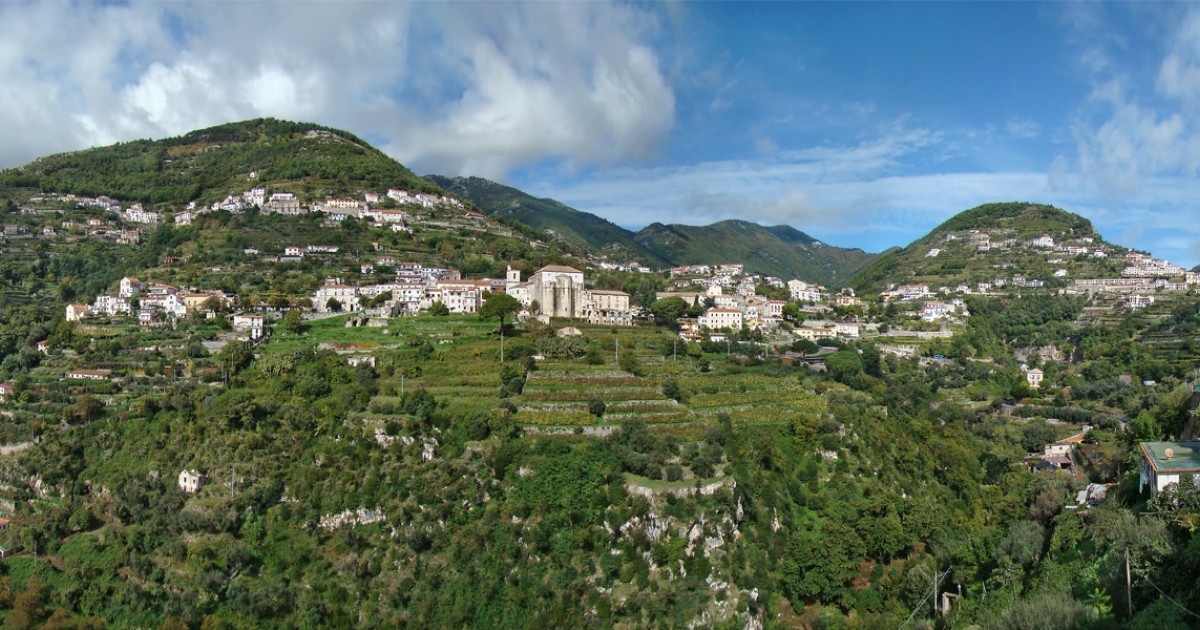

High above Amalfi and Atrani, one village offers a different view of the coast: chestnut woods, terraced lemon groves, stone stairways and medieval churches, rather than traffic-filled waterfronts.
Set at around 400 to 450 metres in the Monti Lattari, it is described as the oldest settlement on the Amalfi Coast. It also offers a calmer base for visitors, with accommodation generally less expensive than in the better-known towns below.
Scala, the oldest village on the Amalfi Coast
The village is Scala, located around 7 km from Amalfi on the inland side of the coast. It is divided into six districts that are linked by sloping lanes and stairways, with the landscape moving quickly between built-up areas, cultivated terraces and wooded paths.
Scala has long been connected to the history of the Republic of Amalfi. During the Middle Ages, it was a centre of power with castles, defensive walls, churches and monasteries.
Several noble families were associated with the village, including the D’Afflitto, Rufolo, Coppola and Sasso families. That history is still visible in its churches, ruins and old buildings, many of which sit above the coastline rather than directly beside it.
A quieter place to stay near Amalfi
Scala’s inland position makes it quieter than the coastal centres, particularly during the busiest periods of the year.
Accommodation in Scala tends to be less expensive than in the better-known towns on the coast. For visitors hoping to split time between walking, historic sites and beach days, the village can work as a base, although daily travel needs some planning.
The best months for walking
April to June and September to October are the most pleasant periods for walking around Scala. The temperatures are more suitable for climbing the village’s steps and following mountain trails than during the hotter summer months.
Medieval churches, ruins and private Arab baths
Scala’s historic centre is centred on the Duomo di San Lorenzo, facing Piazza del Municipio. The church dates back to the 12th century and has a Romanesque-Gothic portal with carved griffins and vine details.
Below Minuta lie the ruins of the Basilica di Sant’Eustachio. Its three-nave structure remains visible, with parts of the medieval Romanesque building still standing among grass and shrubs.
Between Minuta and Santa Caterina are the so-called Arab baths, private thermal rooms associated with the local nobility. The rooms were organised into cold, warm and hot spaces.
Waterfalls and walking routes above the Amalfi Coast
Scala provides access to some of the Amalfi Coast’s inland landscapes, where the terrain is shaped by woods, streams and mountain paths rather than seafront promenades.
Valle delle Ferriere nature reserve
The Valle delle Ferriere extends between the mountains of Scala and the territory of Amalfi. The reserve includes streams, small waterfalls and the remains of old ironworks, where water once powered iron processing.
Santa Maria dei Monti
One of the longer walking routes begins near the Duomo di San Lorenzo. It passes through Campidoglio and Santa Caterina, including the Church of Santa Maria de La Porta, before climbing to around 1,000 metres.
At the top, the church of Santa Maria dei Monti is now used as a refuge. The route passes orchards and lemon groves before reaching beech and chestnut woods at higher elevation.
Torre dello Ziro and Punta d’Aglio
The route towards Torre dello Ziro begins in Pontone. The tower is the most recognisable surviving feature of Scala’s medieval castle. The walk includes viewpoints over Amalfi and Atrani. Above Campidoglio, Punta d’Aglio is a good climbing area.
Chestnuts, mountain cooking and seasonal events
Scala’s cooking reflects its inland location. Local dishes include sheep and goat meat prepared according to farming traditions, as well as pasta dishes and desserts featuring chestnuts.
Chestnuts are central to the village’s food calendar. An October chestnut festival includes tastings and traditional dishes. During summer, Scala also hosts music events and programmes that combine walks with concerts.
Information in this article is based on reporting by The Wom Travel.
Stay inspired for your adventures in Italy —get our weekly newsletter for the latest travel, legal, and lifestyle news.
Source: https://www.idealista.it/