


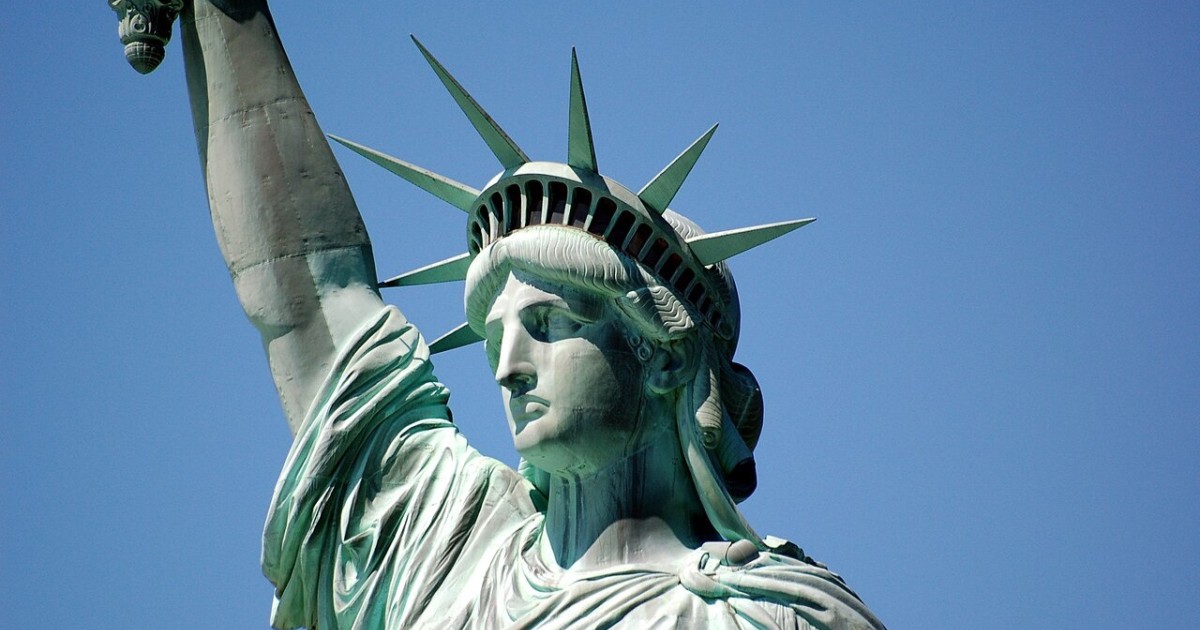

Milan has its own Statue of Liberty, and it actually predates the celebrated American one. It stands on the façade of the Duomo, above the central portal, and is actually called La Legge Nuova (“The New Law”).
It was sculpted by Camillo Pacetti in 1810, more than 70 years before the statue was inaugurated in New York Harbour. Yet amid the thousands of sculptures decorating the cathedral, it is easy to miss.
Here is what to know about Milan’s Statue of Liberty.
The history of La Legge Nuova
Construction of Milan Cathedral began in 1386, but its façade remained unfinished for centuries. The decisive push came from Napoleon Bonaparte, who in 1805 ordered it to be completed ahead of his coronation as King of Italy.
During those years, the Veneranda Fabbrica del Duomo, the body responsible for the cathedral’s construction and upkeep, commissioned dozens of new sculptures. The artists involved included Camillo Pacetti (1758–1826), a Neoclassical sculptor from Rome who taught at the Brera Academy.
La Legge Nuova celebrates a religious concept: the law of the Gospel, or the New Testament. To the right of the central window is its conceptual counterpart, La Legge Vecchia (“The Old Law”), attributed to Luigi Acquisti.
Holding the tablets, it symbolises the Old Testament. Both can be seen by looking above the main portal, where a balcony sits beneath a large window. La Legge Nuova is on the left-hand side of the balcony.
The main statues of Milan Cathedral
The Duomo contains more than 3,400 statues inside and out, spread across its façade, buttresses and 135 spires. The most notable include:
-
The Madonnina: A symbol of Milan, the Madonnina has stood on the tallest spire at a height of around 108.5 metres since 1774.
Modelled by sculptor Giuseppe Perego and made in gilded copper by goldsmith Giuseppe Bini, it measures just over four metres high.
-
Saint Bartholomew Flayed: Inside the cathedral, in the right transept, stands one of the most striking sculptures of the Lombard Renaissance.
Saint Bartholomew, created by Marco d’Agrate in 1562, is depicted after his martyrdom.
- Napoleon’s statue on a spire: Bonaparte’s connection with the Duomo was literally carved in stone. As thanks for completing the façade, Napoleon was commemorated with a statue on one of the spires.
-
The more modern and curious statues: The Veneranda Fabbrica continues to replace damaged sculptures, and during the 20th century, some sculptors allowed themselves a little creative licence.
Among the most surprising figures are said to be a boxer, often identified as Primo Carnera, heavyweight world champion; tennis rackets and rugby balls hidden among the decorations; and a face that, according to a popular legend, resembled Benito Mussolini before being disguised with a turban.
Was the New York statue inspired by the Milan one?
The idea that Frédéric Auguste Bartholdi drew inspiration from La Legge Nuova is evocative and has circulated for years, although it remains an intriguing theory rather than an established historical fact.
more likely explanation for the resemblance is that both statues draw on the same Neoclassical symbolic tradition. The female figure carrying a torch was a widespread allegory in 19th-century European art.
Bartholdi travelled in Italy and was familiar with the country’s art, so it cannot be ruled out that he saw the Duomo. There are no letters or notes confirming this, however.
Where are the five Statues of Liberty?
Paris has five Statues of Liberty. Bartholdi designed and built the work there, so models, prototypes and tributes remained in the city. They are not copies of the American statue, but rather its “sisters” and, in some cases, earlier versions. They are:
- Île aux Cygnes: The best-known, standing around 11.5 metres tall near Pont de Grenelle. It was donated by the American community in Paris and unveiled in 1889. It faces west towards New York, with the Eiffel Tower behind it.
- Musée d’Orsay: This museum holds a reduced-scale model created by Bartholdi. It stood outdoors in the Luxembourg Gardens for more than a century before being moved to the museum in 2012 for protection.
- Jardin du Luxembourg: A bronze copy replaced the original that was moved to the Musée d’Orsay.
- Musée des Arts et Métiers: This museum holds the 1:16-scale model Bartholdi used to refine the proportions. A replica also stands in the forecourt outside.
- Flamme de la Liberté at Pont de l’Alma: A life-size reproduction of the torch alone, given to Paris in 1989.
Living in Milan
Milan attracts visitors for its vast artistic and historical heritage, as well as its many curious stories. Daily life in Milan is also shaped by its role as a business hub. Banks, multinationals, start-ups, fashion houses and creative agencies all have bases here. For anyone seeking job opportunities, particularly in finance, design, technology and communications, it remains Italy’s most active employment market.
Its educational institutions are also highly regarded. The Politecnico, Bocconi, the University of Milan, Cattolica and Bicocca attract students from around the world, giving the city a young, international feel. Then there is the standard of local services.
Source: https://www.idealista.it/