


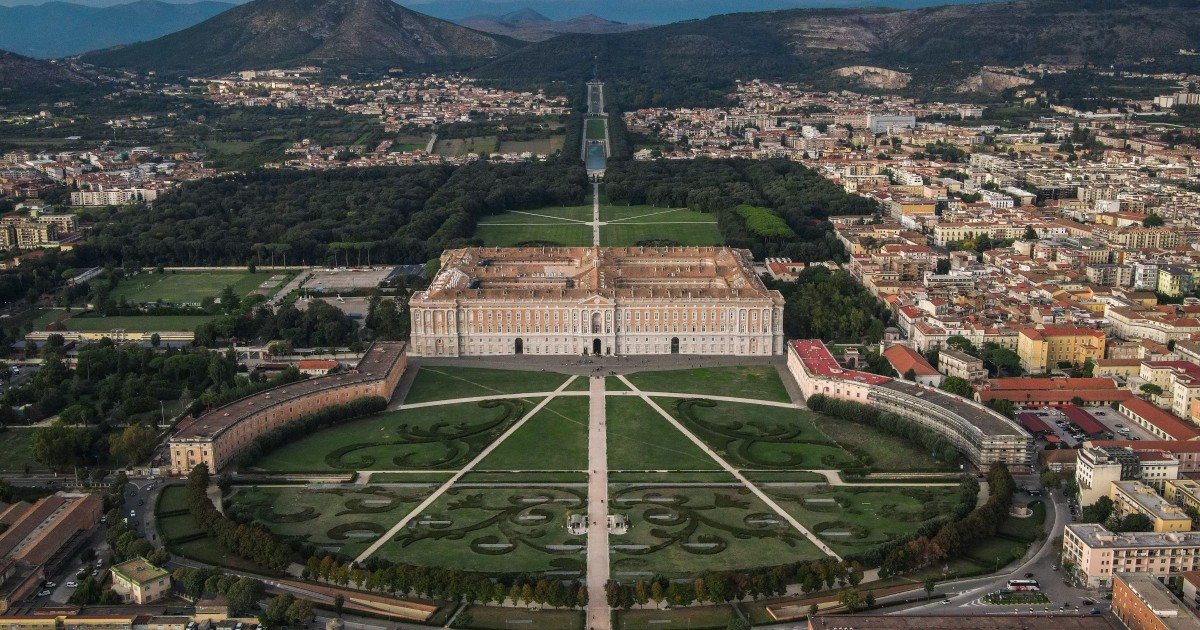

Some places are able to become film sets with hardly any alteration at all: spaces with such obvious grandeur that artificial scenery feels unnecessary.
The Royal Palace of Caserta is one of them.
A UNESCO World Heritage Site since 1997 and a towering achievement of Italian Baroque architecture designed by Luigi Vanvitelli, this extraordinary royal residence has appealed to directors across the world, including George Lucas, Ron Howard and J.J. Abrams.
The films shot at the Royal Palace of Caserta are very different in style, yet the monument has a rare ability to evoke distinct eras, imperial atmospheres and settings that seem to sit outside time.
Star Wars at the Royal Palace of Caserta: George Lucas’s saga
The episode that firmly established the Royal Palace of Caserta as a film location of global importance was undoubtedly George Lucas’s decision to use its spaces for two chapters of the Star Wars saga. In 1999, with Star Wars: Episode I – The Phantom Menace, the palace’s rooms became Queen Amidala’s residence on the planet Naboo.
The film received three Oscar nominations for sound and visual effects, while shots of the palace interiors helped create the refined, imperial grandeur that defines the planet.
Attack of the Clones and Anakin and Padmé’s wedding
The palace’s connection with the Star Wars saga grew even stronger in 2002 with Star Wars: Episode II – Attack of the Clones, again directed by George Lucas.
In this second instalment, the Royal Palace of Caserta hosted one of the most iconic scenes in the entire saga: the secret wedding of Anakin Skywalker, played by Hayden Christensen, and Princess Padmé, played by Natalie Portman.
Filmed in the atmospheric palace gardens, the scene secured this location a lasting place in the global cinematic imagination. Since then, millions of fans have visited Caserta simply to walk through the same setting as this celebrated union.
Mission: Impossible III and Angels & Demons: Hollywood in Caserta in the 2000s
The success of the Star Wars-related productions opened the door to a long line of major international films set at the palace.
In 2006, J.J. Abrams chose Vanvitelli’s architecture as the backdrop for several sequences in Mission: Impossible III, starring Tom Cruise as the iconic Ethan Hunt.
The contrast between the 17th-century elegance of the interiors and the frantic action of the chase scenes created a particularly effective visual result, contributing to the film’s commercial success.
Angels & Demons: Ron Howard and Tom Hanks in Vanvitelli’s halls
Three years later, in 2009, came Angels & Demons, the Ron Howard thriller adapted from Dan Brown’s bestselling novel of the same name.
On this occasion, the Royal Palace of Caserta lent its spaces to portray settings connected with the Vatican, with Tom Hanks playing Professor Robert Langdon as he grapples with dark mysteries unsettling the Holy See.
The monumentality of the spaces, the interplay of light among the columns and the solemnity of the richly decorated rooms suited the dense, claustrophobic atmosphere the director wanted to create.
The film grossed more than $485 million worldwide, indirectly bringing the Royal Palace of Caserta to the attention of a huge audience.
Italian film and television productions: the Royal Palace on home-grown sets
Alongside major Hollywood productions, Italian cinema and television have also made good use of the Royal Palace of Caserta over the decades.
One of the most significant titles is Donne e Briganti (1950), directed by Mario Soldati and set during the Bourbon period, when the palace was still an active royal residence and the historical and geographical context fitted the story perfectly.
A few decades later, in 1980, the palace provided the backdrop for the bizarre and controversial Pap’occhio, directed by Renzo Arbore and starring Roberto Benigni and Diego Abatantuono in an over-the-top satirical story.
The 2000s brought two hugely successful television productions: the miniseries Il Papa Buono – Giovanni XXIII (2003) and Luisa Sanfelice (2004), both broadcast on Rai channels.
More recent productions: The Two Popes and Conclave
The stream of major international productions has certainly not dried up in recent years.
More recent titles filmed at the Royal Palace of Caserta include The Two Popes by Fernando Meirelles, a Netflix production starring Anthony Hopkins and Jonathan Pryce, and Conclave, Edward Berger’s 2025 Oscar-winning film.
Both films made use of the palace’s ability to evoke highly solemn institutional spaces, confirming its versatility as a film location.
Getting to the Royal Palace of Caserta
The Royal Palace of Caserta is easy to reach by train or car. Caserta railway station is a few minutes’ walk from the complex’s main entrance and is served by regional and intercity trains from Naples, Rome and other cities in Campania.
By car, it can be reached via the A1 motorway, which links Milan and Naples, taking the Caserta Sud exit. There are large car parks nearby, and the site can be accessed by larger vehicles.
Living in Caserta
Caserta is more than its Royal Palace. Spending longer than a day there reveals a lively, authentic city, with a historic centre full of Baroque churches, noble palaces and traditional markets. Caserta also makes a practical base for exploring Campania: Naples, the Royal Palace of Portici and the Vesuvius area are all just a short distance away, giving the city a strong position for cultural and scenic itineraries.
Stay inspired for your adventures in Italy —get our weekly newsletter for the latest travel, legal, and lifestyle news.
Source: https://www.idealista.it/