


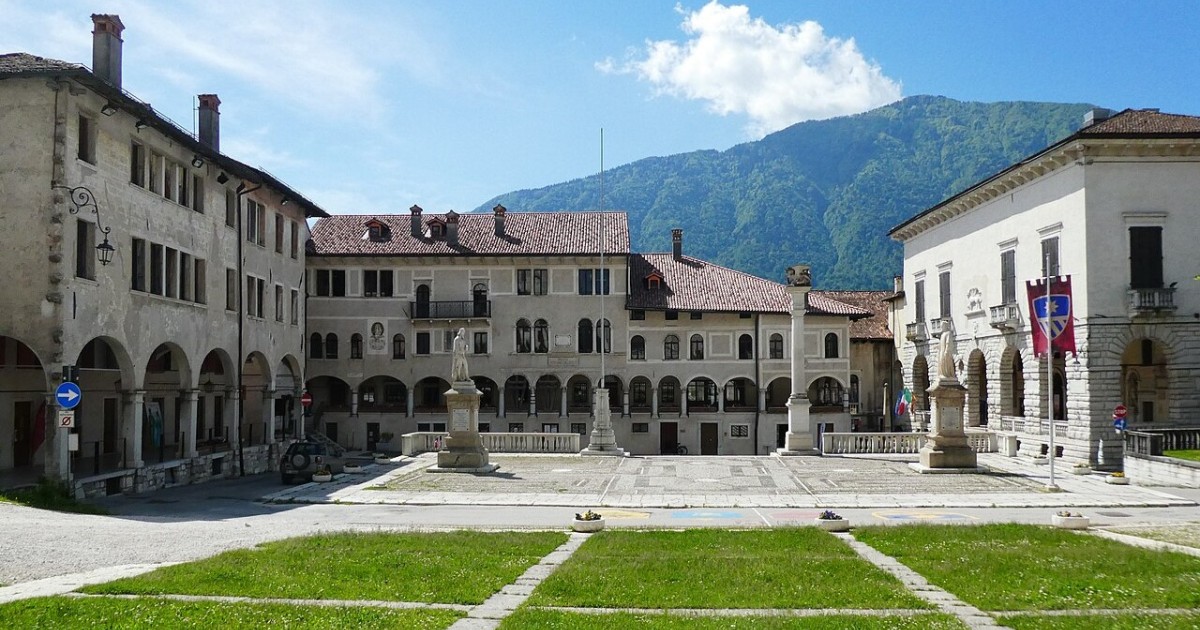

Perched on a hill in the province of Belluno, the walled town of Feltre has one of Italy’s best-preserved Renaissance historic centres. It is surrounded by the Belluno Dolomites and open countryside. The town also hosts events such as its well-established Palio, or historical pageant, and has a food tradition that can hold its own with the best of them.
Here is what to see in Feltre, including the places that should not be missed.
What is Feltre famous for?
Feltre is not only associated with its architecture. The first name that comes to mind is Vittorino da Feltre, considered the father of modern pedagogy. Born here in 1378, the humanist transformed the very concept of education.
There is also Panfilo Castaldi, who local tradition credits with inventing movable-type printing even before Gutenberg.
Feltre also has deep ties to the Republic of Venice. The town became linked to La Serenissima in 1404, a relationship that has left a lasting mark on its architecture and culture.
Another local source of pride is the Palio di Feltre, a historical re-enactment that turns the town centre into a medieval stage every first weekend of August.
What can you see in Feltre’s historic centre in one day?
The walled Cittadella spreads across a compact hill. For a walking visit, these are the main stops in order:
- Piazza Maggiore: the heart of the town and one of Veneto’s most attractive squares. Dominated by the Lombard Fountains, the Palazzo della Ragione and the column bearing the Lion of Saint Mark, it already served as the Roman Forum.
- Church of San Rocco: situated directly beneath the Clock Tower, this 16th-century church stands out for its striking position.
- Clock Tower: recognisable by the crescent moon on its roof, it now houses a “window through time”, a small multimedia museum tracing the changing face of Piazza Maggiore across the centuries.
-
Alboino Castle: at the summit of Colle delle Capre, it has the highest viewpoint across Valbelluna and the Dolomites.
Built by the Lombards in the 6th century on top of Roman structures, it is just a short walk from the centre.
- Via Mezzaterra and its frescoed palaces: the main street of the historic centre, lined with buildings painted with decorative façades and elegant porticoes.
-
Cathedral of San Pietro: rebuilt in Renaissance style, it retains its 14th-century bell tower and an older apse.
Beneath the cathedral is a visitable archaeological area showing Roman settlement in the area.
- Carlo Rizzarda Gallery of Modern Art: housed in Palazzo Bovio Cumano, it holds an unusual collection of wrought-iron art alongside 20th-century paintings and sculptures.
What to see in Feltre with children
Distances are short, routes are accessible, and the town has attractions that keep children curious without leaving adults twiddling their thumbs.
The first stop is almost certainly the Vincheto di Celarda Nature Reserve. A few kilometres from the centre, its flat, clearly signposted trails provide a chance to spot deer, roe deer, fallow deer, mouflon, hares and squirrels. Some routes are also suitable for pushchairs.
In the historic centre, the Clock Tower and its multimedia museum are likely to catch younger visitors’ attention.
For an outdoor day without travelling far, Monte Avena has easily reached pastures and malghe — mountain farmsteads — alongside short walks with wide views.
What is Feltre’s typical food?
The undisputed star of Feltre’s food is pastin, a seasoned mixture of beef and pork typical of Valbelluna. It is eaten grilled with polenta or spread raw on bread, rather like a rustic tartare.
At village sagre, or local food festivals, panico con pastin e formai — bread filled with pastin and grilled schiz cheese — is the classic street food. More inventive restaurants also use it as a filling for paccheri pasta or pair it with Feltre walnuts.
Polenta is not merely a side dish here. It is the centrepiece around which everything else revolves. Polenta made with Sponcio maize, a local variety, has a more pronounced flavour and particular texture.
No account of Feltre’s cooking would be complete without the Lamon beans. And desserts follow the mountain tradition: chestnut cakes made with local moroni chestnuts, tarts filled with Sovramonte mele prussiane apples, strudel and berry-based sweets.
What to see near Feltre
Feltre is a useful base for exploring an area packed with possibilities. The Belluno Dolomites, the Piave, historic towns and high-altitude malghe are all less than an hour away by car.
These are among the most interesting places nearby:
-
Sanctuary of Saints Vittore and Corona: a few kilometres from the centre, on a hill looking over Valbelluna, stands one of Veneto’s most important Romanesque buildings.
Dating back to the 12th century, it has Giotto-style frescoes and a particularly lovely 15th-century cloister.
- Lake Corlo, Arsiè: an artificial lake between Valsugana and Monte Grappa, with turquoise water that recalls a miniature Norwegian fjord.
- The Venetian villas of Cart and Villabruna: from the 16th century, noble families from Feltre chose these hills for their country residences.
Living in Feltre
Feltre is one of those towns with a quality of life that is hard to find elsewhere. With around 20,500 residents, it is neither too small nor too large. There are essential services, a hospital, schools at every level, a station on the Calalzo–Padua railway line, supermarkets, shops and an active cultural scene.
Belluno is only 30 km away, while Treviso and Trento can be reached in just over an hour, and Venice in around an hour and a half.
For a town of its size, Feltre’s cultural life is impressively active. The Palio, the Craft Fair, the Giro delle Mura, concerts at the Teatro de la Sena and Christmas markets keep the events calendar busy through most of the year.
Stay inspired for your adventures in Italy —get our weekly newsletter for the latest travel, legal, and lifestyle news.
Source: https://www.idealista.it/