


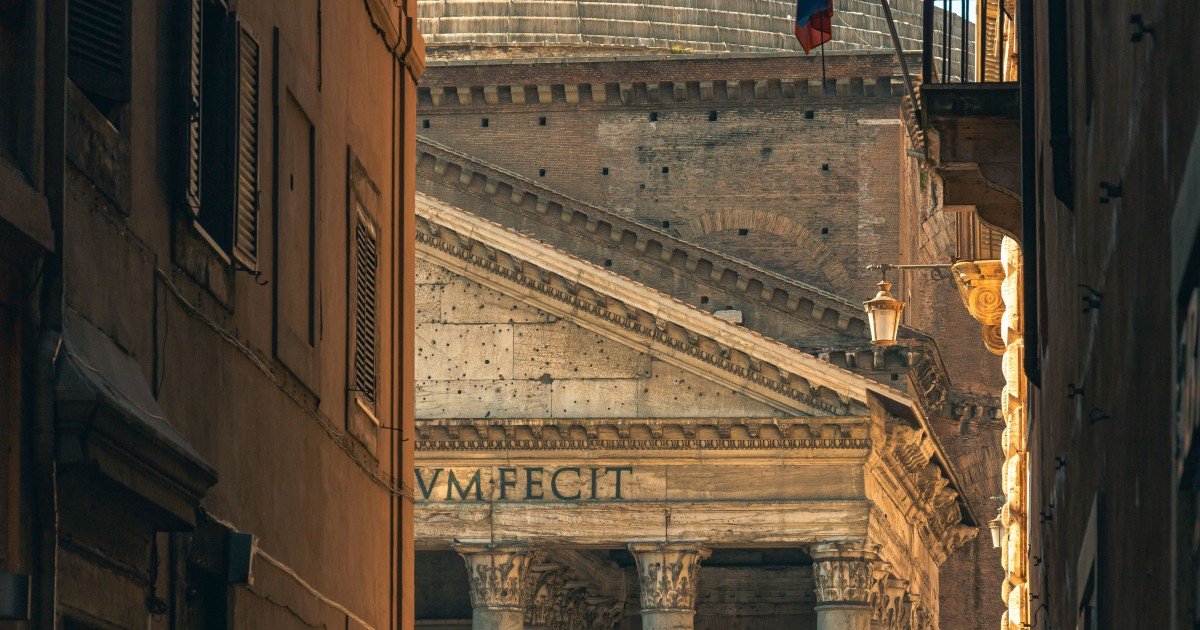

A place on a new international list of the world’s most beautiful buildings puts fresh attention on an Italian monument that never quite fades into the background. It has survived emperors, popes, wars, floods and the daily churn of the historic centre, while remaining part of Rome’s ordinary rhythm.
Outside, scooters edge around the square, café tables fill up, and people pause by the fountain. Inside, the noise falls away beneath a dome whose technical confidence still feels slightly unreal.
The Rome monument selected for 2026
The building is the Pantheon, one of the defining works of ancient Roman architecture. It was included in Time Out’s 2026 selection of the world’s most beautiful buildings, recognised for its immense dome, precise proportions and remarkable state of preservation.
The structure seen today was built under Emperor Hadrian, generally dated to around AD 118–128, on the site of an earlier temple commissioned by Marcus Agrippa. Agrippa’s name remains across the front of the portico, which has caused a fair bit of understandable confusion over the centuries.
The Pantheon was initially a Roman temple. It is now the Basilica of St Mary and the Martyrs, an active Catholic church. That continuing religious role has played an important part in its survival, while also shaping the experience of visiting it today.
The oculus: Rome’s most dramatic ceiling opening
At the centre of the dome sits the oculus, Latin for “eye”. This circular opening is nearly nine metres wide and connects the interior directly with the sky.
It has no glass or cover. Sunlight enters in a concentrated beam and slowly travels around the interior as the day passes, picking out marble, columns and visitors in its path.
The oculus is both practical and theatrical, though it was not designed as a modern spectacle. It reduces the dome’s weight at its highest point while giving the room a changing relationship with weather, season and daylight.
One particularly talked-about moment occurs around 21 April, Rome’s traditional birthday. Time Out notes that the midday sun can align with the entrance area in a way that floods the threshold with light.
Roman engineering that still holds its own
The Pantheon is admired not simply because it has lasted. The cleverness lies in how the Romans made such a large dome possible without modern steel reinforcement.
The walls at the base are thick and heavy, carrying the enormous weight above. As the dome rises, its materials become lighter. Builders used different types of aggregate in the concrete, reducing the load closer to the oculus.
These decisions are easy to miss amid the scale of the space. The dome feels smooth and effortless, which is often the mark of very good engineering.
The entrance has a different character. A deep portico with granite columns leads into the circular interior, creating a shift between the busy square and the calm rotunda. That combination of classical front and domed interior influenced later buildings across Europe and beyond, particularly churches, libraries, museums and civic spaces.
Visiting the Pantheon in Rome
Visiting the Pantheon now requires a timed ticket for most visitors, while access conditions can differ for worshippers, residents and organised groups. Entry procedures, reduced tickets and service schedules can change, so the latest details are best checked through the Italian Ministry of Culture before making plans.
As an active basilica, respectful clothing is expected. Shoulders and knees may need to be covered, particularly during religious services. Access can also be limited during Mass, ceremonies or security-related closures.
A short walk through central Rome
The Pantheon sits in the middle of a very walkable part of Rome. Piazza Navona is nearby, built over the footprint of the ancient Stadium of Domitian and now framed by Baroque façades and fountains. Its broad open space feels like the opposite of the Pantheon’s inward-looking rotunda.
Campo de’ Fiori lies a little further south-west and has a more workaday character in the morning, when stalls set up in the square. The surrounding streets offer small food shops, bakeries and traditional Roman trattorie, although central locations can be more expensive than menus initially suggest.
The best part of this area is often the in-between bit with lesser-known landmarks. Narrow lanes open into unexpected squares, fragments of ancient stone appear in building walls and laundry still hangs above streets that fill with visitors every day.
Ancient Rome beyond the Colosseum
The Colosseum is Rome’s most recognisable ancient monument, but the Pantheon provides a very different encounter with the city’s past. Its interior is largely intact, its purpose has changed without disappearing, and its engineering can be read directly in the space around you.
This is where the building earns its place on a global architecture list. Its appeal is not only its age or the drama of the dome. It is the rare feeling of entering a structure that remains both monumental and completely embedded in the life of the city.
Stay inspired for your adventures in Italy —get our weekly newsletter for the latest travel, legal, and lifestyle news.
Source: https://www.idealista.it/