


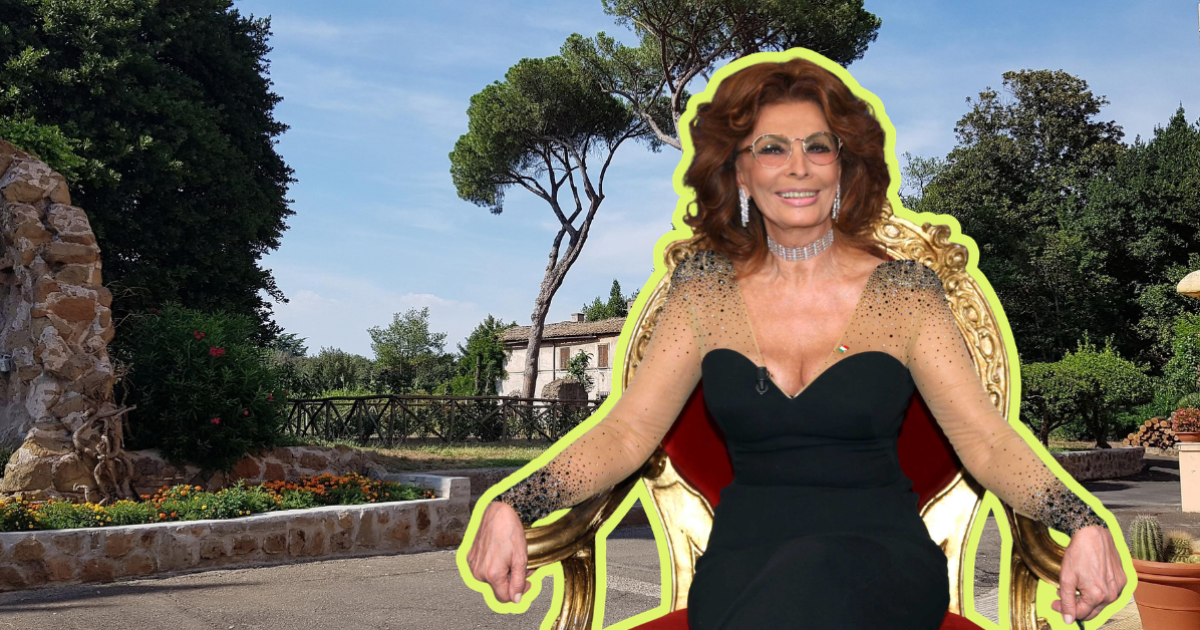

If the Appia Antica is the regina viarum, or “queen of roads”, Sophia Loren is arguably the queen of Italian actresses, admired by audiences and critics alike. Loren, who now lives in Switzerland, owns an exceptionally prestigious villa on the Appia Antica, a home she shared with her husband Carlo Ponti for many years.
The house is reached along a long tree-lined drive. Beyond a seemingly unremarkable door, visitors enter a dining room carved into the living rock, with an ancient Roman mosaic set into the floor.
Today, Sophia Loren’s villa is for sale. Officially on the market since September 2026, the property has renewed interest among fans of history, high-end property and Italian cinema.
Where Sophia Loren’s villa is: Rome’s Appia Antica
The villa stands within the Appia Antica Regional Park, Rome’s largest green area, internationally recognised for its landscape of ancient tombs, umbrella pines and historic sampietrini cobbles.
Despite being just minutes from the capital’s centre, this area retains a quiet and calm that is hard to come by elsewhere in a large European city. Buying here is not simply about a house and garden, but a way of life protected by landscape restrictions intended to safeguard the area over time.
The combination of easy access to the city and an almost countryside-like atmosphere makes properties along the Appia Antica some of the Roman market’s rarest and most sought-after. This villa benefits especially clearly from that dual character, thanks in part to a large private park that provides visual and acoustic separation from the road.
The history of Loren’s villa: from basalt quarry to film-world residence
The property was built during the 19th century over the remains of an ancient Roman basalt quarry. The volcanic stone extracted there was most likely used to build and maintain the Appian Way itself. The architectural design is attributed to Andrea Busiri Vici, a member of a family that left a significant mark on Rome’s residential architecture during the 19th and 20th centuries.
During the 1950s, the villa became the home of film producer Carlo Ponti, who at that time was still connected to his first family. It was then that the house became a meeting point for figures in Italian and international cinema.
Its association with Sophia Loren, who later became Ponti’s wife, is therefore more evocative and symbolic than strictly biographical. Even so, it gave the property the name by which it is now widely recognised.
The 1980s restoration
After Ponti’s period at the villa, and with Loren now living in Switzerland, the property was acquired by a new owner. During the 1980s, it underwent a complete restoration that retained the original architectural layout while updating the interiors.
The work helped preserve the villa’s historic identity while maintaining its practicality and comfort.
Inside the villa: layout, rooms and features
The villa extends across roughly 700 m², arranged over two levels connected by internal staircases. The main floor is designed for entertaining and receiving guests, with three sitting rooms with fireplaces looking out onto the garden, as well as a kitchen and guest facilities.
The upper floor is more private, with five bedrooms and five bathrooms. In total, the property has seven bathrooms. Several separate entrances, including three main access doors, have historically allowed people to move around the estate with considerable discretion.
The library and winter garden
Among the upper-floor rooms, the library and winter garden stand out. The latter is a bright, glassed-in space acting as a link between the interior of the house and the greenery outside.
These rooms suggest a home used as a place for cultural gatherings, where conversation and creativity naturally found a setting amid book-lined walls and plants.
The dining room in a Roman cave: the villa’s centrepiece
The villa’s most unusual and celebrated space is undoubtedly its dining room, created inside an ancient Roman cave. Its walls and vaulted ceiling are made of dark tuff blocks, while the floor preserves an original mosaic depicting the head of Medusa, an element of exceptional historical and artistic value.
Tradition has it that Carlo Ponti liked to lead guests through the more modest entrance before suddenly revealing this room, a dramatic reveal suited to the instincts of a major film producer.
The park and adjoining buildings: nature, history and event space
The villa is surrounded by a private park of around 11,000 m², including the former basalt quarry, now landscaped as a garden, mature trees, open lawns and shaded areas.
A park of this size in this part of Rome is exceptionally rare within the capital’s high-end property market. The greenery serves more than an aesthetic purpose: it provides complete privacy, a favourable microclimate and natural sound insulation from the surrounding traffic.
The former stables: 467 m² for events and receptions
Behind the main building are the former stables, restored and converted into a multi-purpose space of roughly 467 m².
This structure can be used for private receptions, cultural events or corporate occasions, adding value for a buyer considering the property not only as a private residence but also as an exclusive venue.
Notable guests: Italian cinema and Hollywood names
During the years Carlo Ponti lived at the villa, it became one of the entertainment world’s most popular meeting places. Contemporary accounts link the residence with directors including Federico Fellini, Vittorio De Sica and Roberto Rossellini, major figures in Italian neorealist cinema.
Actors were also among the guests, including Alberto Sordi and Silvana Mangano, alongside Hollywood stars such as Anthony Quinn and Kirk Douglas, who spent extended periods at the property at certain times. Many of them worked with Ponti on film productions of the period.
How much does Sophia Loren’s villa cost?
On the official website of the agency handling the sale, the villa’s price is listed on request, as is common in the ultra-premium property market.
The fact that the villa has not yet found a buyer after several years shows how particular and specialised this part of the market is. It requires a very specific kind of buyer, able to appreciate its identity in full.
What to know before buying a historic luxury villa in Rome
Anyone considering a property of this kind should be aware that the Appia Antica Regional Park is subject to strict landscape and cultural heritage restrictions. Any building work, including renovation, extensions or external alterations, requires the appropriate authorisation from both the Soprintendenza, Italy’s heritage authority, and the park itself.
A property of around 700 m² with an 11,000 m² park also calls for significant ongoing management. Routine and extraordinary maintenance costs, such as gardening, systems upkeep, cleaning and any conservation work on historic structures, can be substantial. Owners of this kind of property commonly rely on a dedicated property manager or a specialist company for historic residences.
Stay in the know about living in Italy as a foreigner—get our weekly newsletter for the latest travel, legal, and lifestyle news.
For a taste of the high life, sign up for the monthly luxury market round-up.
Source: https://www.idealista.it/