


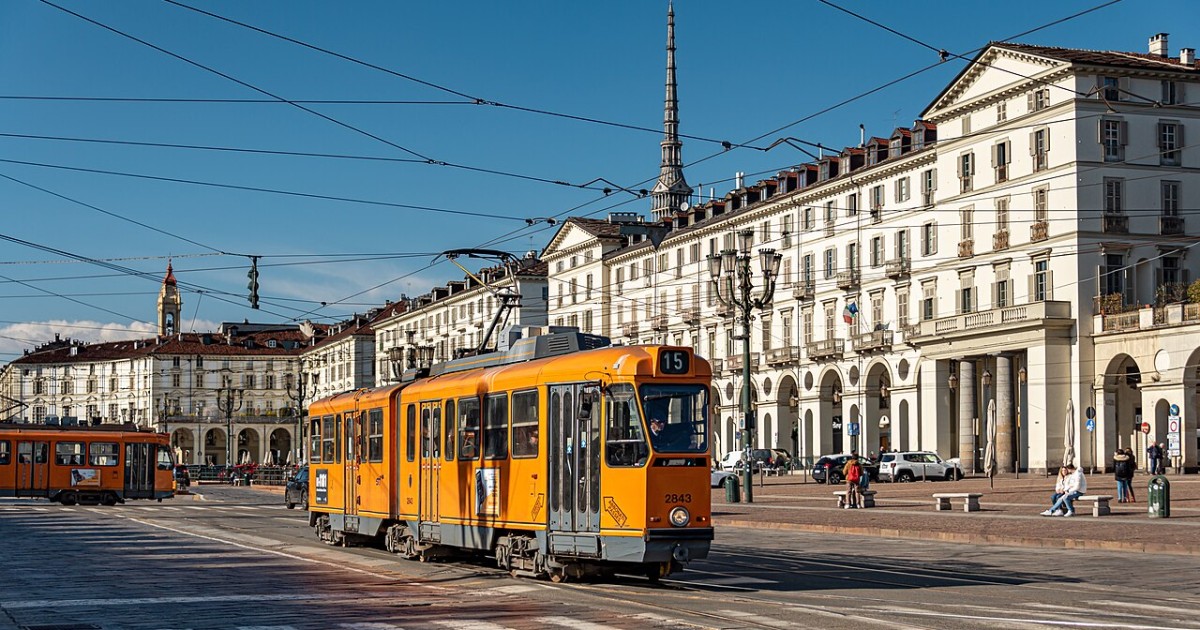

Covering more than 38,000 square metres, this huge 19th-century square has room for five regulation football pitches, yet it remains part of everyday city life rather than a mere tourist backdrop.
Beneath its long arcades, the scene opens onto the Po, the surrounding hills and a story stretching from the Napoleonic era to the present day.
Where Piazza Vittorio Veneto is in Turin
Piazza Vittorio Veneto, Italy’s largest square, lies in Turin’s historic centre, at the end of Via Po, the elegant arcaded street that begins at Piazza Castello and leads down towards the river.
Anyone crossing the square finds themselves among 19th-century Savoy architecture, just a short walk from the river, the hills and the Murazzi. There is also a detail that is not immediately obvious in photographs: the square is slightly sloped, with the Via Po end higher than the riverside end.
The difference in level becomes clear beneath the arcades, where the arches initially seem lower and more enclosed, gradually becoming taller as they lead towards the Po.
How to reach the square
Those arriving in Turin by train can reach Piazza Vittorio Veneto on foot in under 20 minutes from the main stations. It is also connected to the centre by local trams and buses.
The square lies in the heart of the ZTL, or limited traffic zone, so visitors travelling by car need to leave their vehicle in parking areas outside the zone and continue on foot. The walk through the centre is pleasant, passing along some of the city’s most attractive streets.
The history of Piazza Vittorio Veneto: military parades and city life
The area now occupied by Piazza Vittorio Veneto did not always look this way. For centuries, this part of the city’s edge was used for military purposes. The open riverside space served as a parade ground, reserved for troop gatherings and manoeuvres.
The turning point came during the Napoleonic era. The demolition of Turin’s old city walls and the reconstruction of the stone bridge across the Po made the city’s expansion possible.
This led to plans for a large, theatrical square aligned with Via Po and the expansion of Borgo Nuovo. It was an ambitious project, requiring the historic city’s elevation to be connected with that of the riverbank. Architect Giuseppe Frizzi was commissioned to design the layout in the early decades of the 19th century, and works were completed during the 1820s.
The name change after the First World War
The square was originally named after King Vittorio Emanuele I, at a time when the House of Savoy was at the centre of Turin’s political and symbolic life. Its name remained unchanged for almost a century, until the end of the First World War.
In 1918, Italy’s victory at Vittorio Veneto marked the end of the conflict. To commemorate that event, the square was renamed Piazza Vittorio Veneto.
Today, it is a natural gathering point for the celebrations of Saint John the Baptist, Turin’s patron saint, with fireworks visible from the square and the riverside, and crowds filling the open space and arcades.
What to see in Piazza Vittorio Veneto
The square’s most recognisable feature is the arcades running along its three built-up sides. They form a unified architectural element, designed to give visual consistency to buildings constructed at different times.
Another detail that shapes the square’s appeal is its Empire-style street lamps, with cornucopia-shaped arms, installed during the 1960s.
Gran Madre di Dio and views over the Po
At the riverside edge, the eye is naturally drawn to the Gran Madre di Dio church, which stands on the opposite bank of the Po with its neoclassical façade.
Built between 1818 and 1831 to celebrate Vittorio Emanuele I’s return from exile, the church creates a visual dialogue with the square once named after him. The view from the middle of Piazza Vittorio, taking in the bridge, river and dome in the background, is one of Turin’s most photographed scenes.
Things to do near Piazza Vittorio Veneto
Leaving Piazza Vittorio along Via Po towards the centre brings you onto one of Turin’s best-known arcaded streets with plenty of things to explore. The stretch has independent and antiquarian bookshops, shops selling traditional Piedmontese sweets, historic cafés and artisan workshops.
The Murazzi del Po
Heading down from the square towards the river leads to the Murazzi del Po, old brick embankments that run along the left bank of the Po.
Historically used for warehouses and storage facilities, they began to be transformed during the 1980s into one of the symbols of Turin’s nightlife, with bars, cultural associations, summer concerts and riverside walks.
Borgo Po and the hillside
Crossing Vittorio Emanuele I Bridge leads into Borgo Po, a residential district at the foot of Turin’s hills. The contrast with the centre is immediate: narrower streets, less traffic and a more intimate scale.
The hillside can be reached on foot along its paths, by bus or by funicular, with villas, gardens and viewpoints over the city.
Living near Piazza Vittorio in Turin
Living close to Piazza Vittorio Veneto is one of the most sought-after residential options in central Turin. The buildings facing the arcades contain desirable flats, often with high ceilings and views over the square or 19th-century internal courtyards.
The area is well served and lively without being chaotic during the day. The arcades also make it easy to get around on foot in all kinds of weather. Living in Turin overlooking Piazza Vittorio remains a privilege, but homes in the area can be found among idealista’s listings:
Source: https://www.idealista.it/