


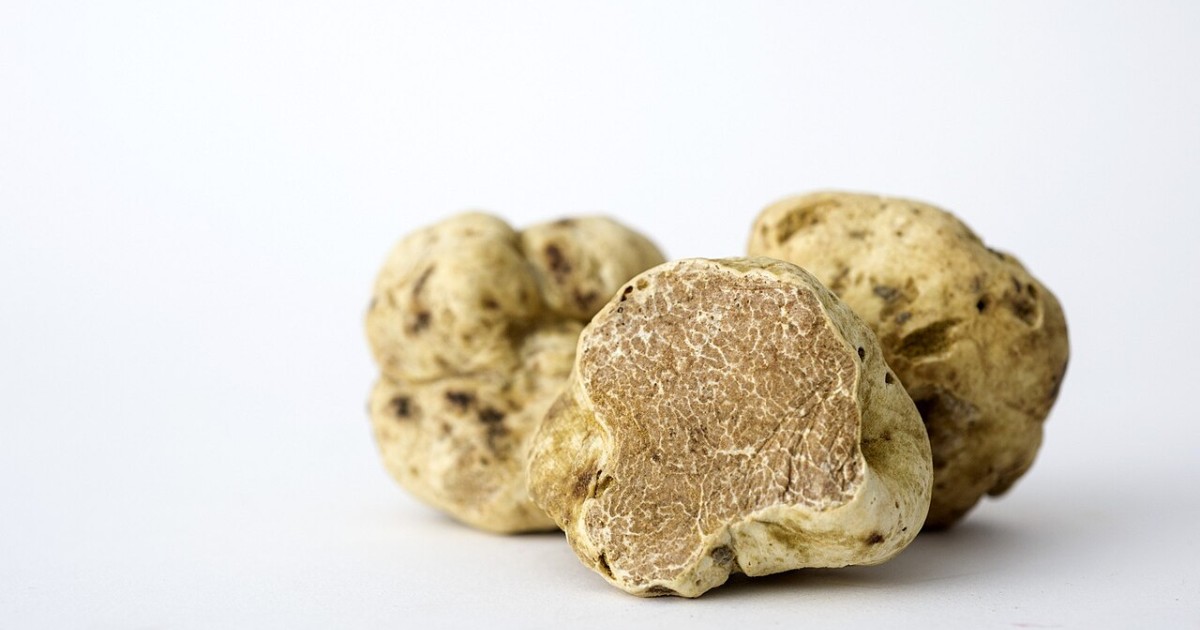

Described as “the Mozart of mushrooms” by the celebrated composer Gioachino Rossini, the white truffle is among the most prized and sought-after ingredients in Italian cooking.
It grows underground, cannot be easily cultivated, and has an unmistakable aroma that brings to mind fresh garlic, aged cheese and damp woodland. Its scent has won over some of the world’s most exclusive kitchens.
What is the prized white truffle, Tuber Magnatum Pico?
The world’s most highly valued white truffle is Tuber Magnatum Pico, a hypogeous fungus — meaning it grows underground — belonging to the Tuberaceae family.
Unlike the black truffle, its outer surface has no warts. It is smooth and velvety, with colours ranging from pale yellow to golden ochre, which is where its “white” name comes from.
- Its size varies between 2 and 10 centimetres in diameter, with a weight of 10 to 200 grams, though exceptional specimens can be considerably larger.
- Its aroma is its defining trait: complex and persistent, with notes reminiscent of fresh garlic, shallot, Grana cheese and damp undergrowth. A weak scent is often a sign of immaturity or lower quality.
Its scientific name was coined in 1788 by Vittorio Pico, a doctor from Turin, who named it Tuber Magnatum. The name comes from the Latin magnatus, meaning “a man of high rank”, in tribute to the nobles and aristocrats who were particularly fond of it.
Where white truffles are found in Italy: the most productive regions
The prized white truffle is a typically Italian product. Small quantities can also be found in Slovenia, Croatia and some parts of southern France, but Italy still accounts for almost all global production.
Not every Italian region is equally suited to producing this fungus.
Piedmont: the world capital of white truffles
The best-known and most productive area is undoubtedly Piedmont, particularly the land around Alba in the province of Cuneo. The Alba white truffle is considered the most prized in the world and has a history stretching back to 1928, when Giacomo Morra organised the first exhibition devoted to Tuber Magnatum during Alba’s Wine Fair.
That initiative led to the Alba International White Truffle Fair, now one of the world’s most important food events, held in the Langhe each autumn. It is no coincidence that the nearby village of Roddi has had a true “University of Truffle Dogs” since 1880, Italy’s oldest training school for truffle-hunting dogs, known locally as cani trifolai.
Umbria, Marche and Molise: other white-truffle areas
Alongside Piedmont, several regions in central and southern Italy produce white truffles of notable quality.
- In Umbria, the area around Spoleto and the Valnerina has long been associated with truffle hunting.
- In Marche, the land around Acqualagna, in the province of Pesaro and Urbino, hosts one of Italy’s most significant truffle fairs, where white truffles are the undisputed stars of autumn.
- Molise is less familiar to the wider public, but its abundance of woodland and limestone soils provides productive areas of real interest.
Smaller quantities of good-quality white truffles can also be found in parts of Tuscany, Abruzzo and Lazio, confirming how closely this fungus is tied to particular ecosystems that occur in several areas of the peninsula.
Which trees do truffles grow beneath?
Just as crucial is the presence of the right trees: the white truffle’s symbiotic plant partners. The fungus forms this relationship mainly with the following tree species:
- Hornbeam and black hornbeam, among Tuber Magnatum’s preferred symbiotic partners;
- Turkey oak and English oak;
- Hazel;
- Poplar, including white, black, aspen and Carolina poplar;
- Sessile oak;
- Willow;
- Lime tree.
The presence of these trees in well-drained limestone soil is the first thing to look for when identifying an area that may be suitable for white truffles.
The best time to collect white truffles
The white-truffle picking season is one of the most eagerly anticipated parts of Italy’s culinary calendar. Tuber Magnatum Pico reaches maturity during autumn and early winter.
Official collection generally begins in September and continues until January, with the heart of the season falling in October, November and December.
Timing varies according to the weather each year. Seasons with rainy summers and damp autumns tend to produce more plentiful, fragrant truffles, while summer drought can seriously affect production.
The season for the bianchetto truffle, Tuber Borchii, is entirely different: it is collected between January and the first half of April.
How to buy fresh white truffles: markets and fairs
Anyone unable to search for them directly in the woods can find fresh white truffles at specialist markets that come alive in producing towns during autumn. The most important include:
- Alba International White Truffle Fair in Cuneo, Piedmont, held every weekend in October and November;
- Acqualagna National White Truffle Market Exhibition in Pesaro and Urbino, Marche, held in October and November;
- Sant’Angelo in Vado Truffle Exhibition in Pesaro and Urbino, Marche;
- Local markets in Spoleto, Norcia and other Umbrian towns.
During the season, fresh white truffles can also be found at specialist wine shops and high-end delicatessens, or bought online through certified sellers that guarantee the product’s origin and freshness.
How much do white truffles cost?
White truffles are among the world’s most expensive foods. Their price varies considerably according to the quality of the season, the size of the truffle, its region of origin and market availability.
During the season, the average price ranges between €2,000 and €5,000 per kilogram. It can climb well beyond this level in years of low production or for particularly large specimens.
Source: https://www.idealista.it/