


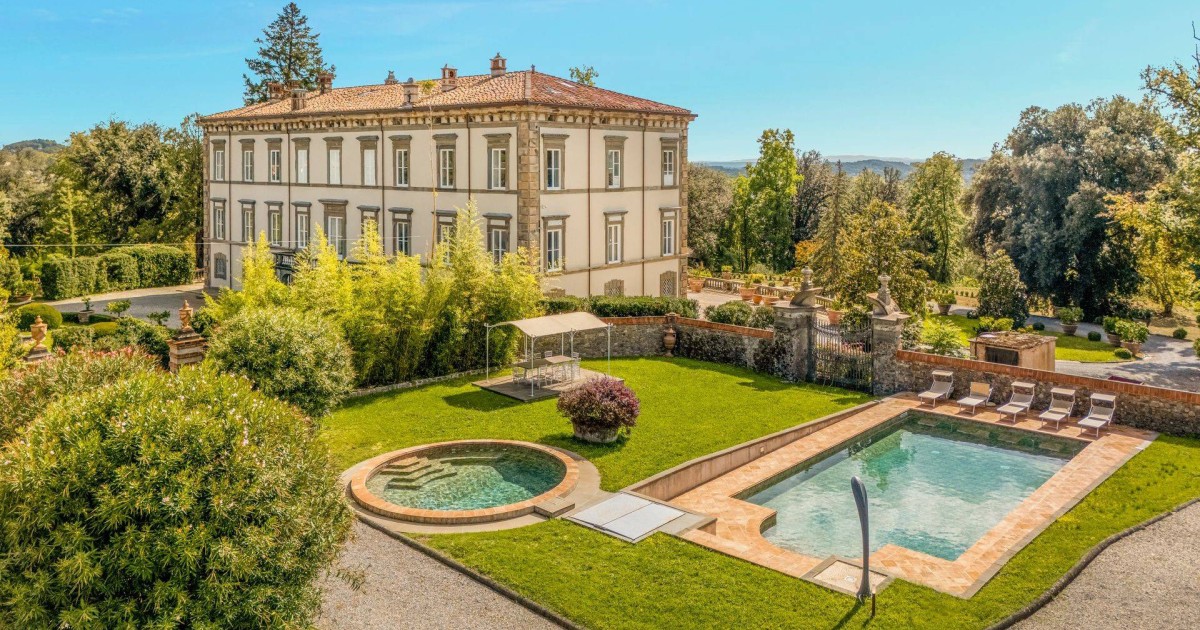

Among the many listings published on idealista, a few stand out as truly exceptional. This is the case with one of Tuscany’s most striking historic residences, set in the heart of the countryside around Lucca, among gentle hills and scenic surroundings.
The 18th-century villa was once the residence of Carolina Bonaparte, Napoleon Bonaparte’s sister and Queen of Naples.
It is listed at €15 million.
The carefully preserved and restored property is surrounded by around 6 hectares of land. Alongside the main villa, it includes an elegant annexe, a private church, a historic limonaia or lemon house, stables, the estate manager’s house and two swimming pools set within the grounds.
Just minutes from Lucca’s Renaissance walls, the villa lies in a peaceful setting amid the Tuscan countryside.
Originally built in the 16th century, the villa extends to around 2,500 m² and was transformed in the 18th century by Coriolano Orsucci into a grand country residence with monumental interiors.
Carolina Bonaparte bought it in 1836, after which the estate passed to other prominent Italian noble families.
The distinguished Baroque architect Filippo Juvarra contributed to the property’s appeal by designing the entrance gate to the walled garden on the western side, a chiusa agreste, a rural enclosed garden typical of the Lucca area.
The villa’s focal point is the piano nobile, or principal floor, dominated by a majestic 125 m² double-height reception room. It is decorated with stucco by the master Sebastiano Puccini and features two imposing canvases attributed to Pier Dandini, depicting the Battle of the Milvian Bridge and The Rape of the Sabine Women.
Carolina Bonaparte may have brought the works to the villa herself. The adjoining rooms, including the celebrated ‘red room’ with silk-covered walls, retain their original 18th-century furnishings and decoration.
The fully restored ground floor contains the former kitchens, sitting rooms, bedrooms and service areas. The second floor, which is partly in need of restoration, has further bedrooms overlooking the countryside as well as bathrooms. The attic is accessible. Next to the villa stands a finely restored, independent annexe of around 300 m².
A short walk away, the private 18th-century chapel remains intact in its original architectural form, adding a further historical and spiritual dimension to the estate.
The Italian-style garden, which contains two swimming pools, brings together nature and formal design through gravel paths, terracotta statues, box hedges and lemon trees in decorative pots. During summer, the pots are arranged throughout the grounds; in winter, they are kept in the large, fully restored limonaia of around 300 m², which can also be used for events or exhibitions.
The 18th-century stables and estate manager’s house, which extend to around 1,150 m², can also be purchased separately. They retain much of their original period character and could be adapted for new uses, such as refined residences or welcoming hospitality accommodation.
Source: https://www.idealista.it/