



Tuscany really does have a medieval village that reappears at irregular intervals from the bottom of a lake. Tuscany’s Atlantis is not a legend. It is Fabbriche di Careggine, beneath the waters of Lake Vagli in Garfagnana. It last resurfaced in 1994, drawing more than one million visitors. T
Today, after delays connected with drought and the pandemic, work is under way on the possibility of draining the reservoir again between 2027 and 2028.
Tuscany’s Atlantis exists: what lies beneath Lake Vagli
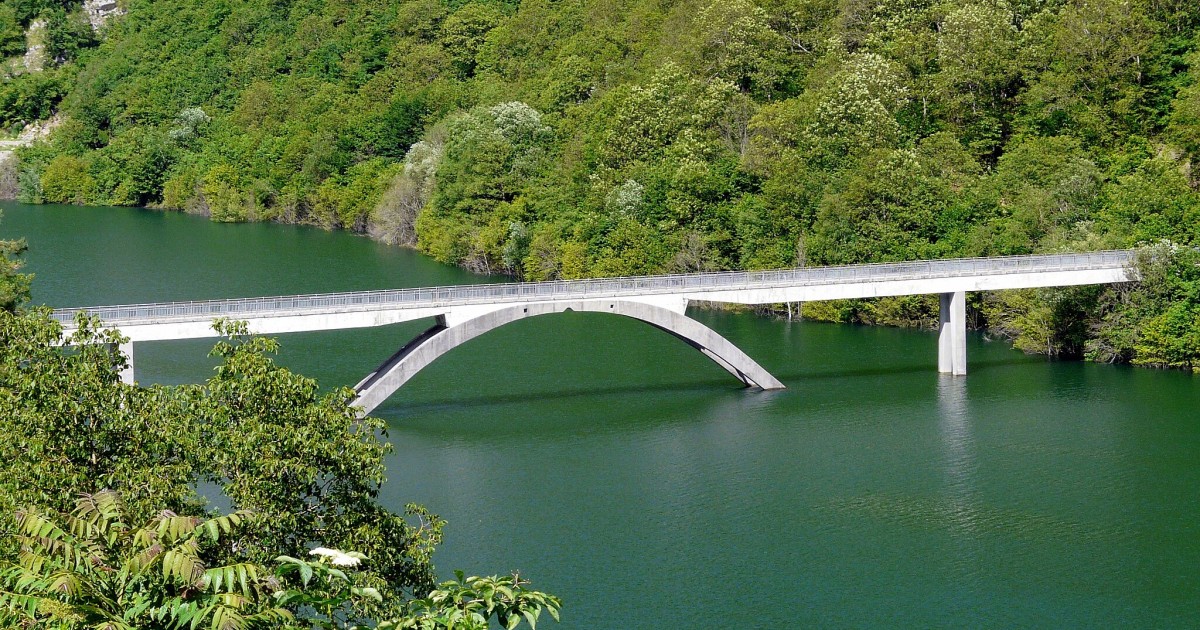
Beneath the emerald-green surface of the Vagli reservoir lies Fabbriche di Careggine, a settlement where the remains of stone houses, streets and religious buildings can still be made out.
When the reservoir is drained for major maintenance work, the homes re-emerge, along with the old mill, cemetery, a three-arched bridge and the Church of San Teodoro. Built in 1590, the church has a square-plan bell tower.
Brescia blacksmiths and the Via Vandelli: the village’s origins
The village’s roots date back to the 13th century, when a small community of blacksmiths from the Brescia area settled in Garfagnana to work iron from nearby Monte Tambura. Metalworking made the settlement an important point for trade. Under the Este rulers, Duke Francesco III d’Este granted residents significant privileges in 1755, including exemption from military service and concessions on the transport of goods.
This period also saw the development of the Via Vandelli, a major road linking Modena and Massa, which crossed the Edron stream by way of a masonry bridge. When metalworking declined during the 19th century, the local economy returned to farming and pastoral work. Marble quarrying in the early 20th century later brought employment and electricity back to the area.
The dam: construction and relocation, 1947–1953
The Edron dam was designed in 1941 to supply hydroelectric power. Work began in 1947 and ended in 1953. The dam, around 92 metres high, created a reservoir with a capacity of more than 34 million cubic metres. As the water rose, the 146 residents of the village’s 31 homes were moved to new housing built on the Vagli Sotto promontory.
The water covered slate roofs, streets and the symbols of village life, preserving its image beneath the lake’s surface. Since then, Fabbriche di Careggine has become a remarkable case: an intact medieval settlement protected by water and only visible when the reservoir is completely drained.
When it resurfaces: four appearances and the 2027–2028 window
Lake Vagli has only been completely drained four times: in 1958, 1974, 1983 and 1994. The 1994 resurfacing attracted national and international attention. In theory, the operation should have happened more regularly, but recent years have been affected by water shortages, along with complicated technical and organisational considerations.
According to current proposals, another possible window falls between summer 2027 and 2028, linked to concession deadlines. It is not a confirmed date, but a timeframe currently under consideration. In the meantime, anticipation is growing.
Lake Vagli today: adventure and contemporary art
Even without the reservoir being drained, the Lake Vagli area has plenty to see. The Apuan Alps form the backdrop to suspended routes, viewpoints and marble sculptures. A half-day or weekend visit can combine walking, a bit of adrenaline and slower time beside the water.
The Volo dell’Angelo zip line
A zip line of around 1,500 metres crosses the lake at heights reaching 350 metres, with speeds that can approach 130 km/h. It can be used individually or in pairs, including in a seated position, with views framing Vagli Sotto and the part of the lake where Fabbriche di Careggine lies.
Suspension bridge with glass sections
The Tibetan bridge linking the two shores at the mouth of the Edron stream provides a privileged view over the reservoir. A central section with tempered-glass panels allows visitors to look down at the water beneath their feet, creating a memorable but accessible crossing.
Park of Honour and Dishonour
On the lakeshore is a collection of monumental Carrara-marble sculptures dedicated to figures who have sparked public debate. The works include tributes, such as one to Diesel the dog, and satirical pieces depicting well-known figures from international current affairs.
Campocatino and Garfagnana’s trails
A short distance from Vagli Sotto is the Campocatino mountain pasture, a green glacial basin framed by historic stone buildings known as caselli. The area is recognised as a LIPU bird-protection oasis and is home to a statue dedicated to the Guardian Angel.
Walks begin here towards Monte Roccandagia or the slopes of Monte Tambura, along hiking paths that cross woods and pastureland.
Article seen on The Wom Travel: La “Atlantide della Toscana” esiste davvero: un paese sommerso aspetta di tornare alla luce
Source: https://www.idealista.it/