


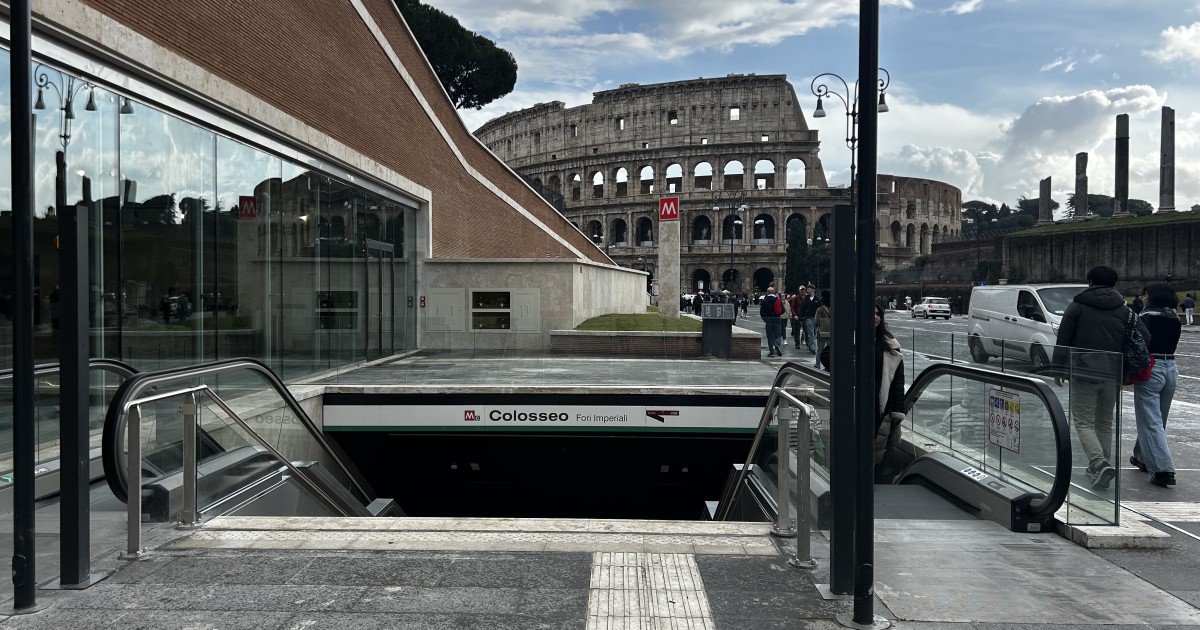

Italy has two entries among the world’s seven most beautiful stations, according to Prix Versailles, the annual architecture and design awards announced at UNESCO.
The 2026 World’s Most Beautiful Achievements selection includes one metro station in Rome and another in Naples. Prix Versailles highlights architecture and design that contribute to the living environment, though it has not published individual explanations of how each station was selected.
Rome’s Colosseo–Fori Imperiali station receives global recognition
The station is Colosseo–Fori Imperiali, a metro interchange on Via dei Fori Imperiali, close to the Colosseum, Roman Forum and Palatine Hill. Prix Versailles lists it among its World’s Most Beautiful achievements in the Passenger Stations category.
An underground museum beneath Ancient Rome
Colosseo–Fori Imperiali is a stazione museo, or museum station. Its route underground presents finds uncovered during construction alongside objects from the archaeological park’s own collections.
The displays follow roughly 2,000 years of Roman history, starting with the Rome of the kings and continuing through the Republican and imperial periods. The experience is less like a conventional museum visit and more like a carefully curated interruption to an ordinary metro journey.
Construction revealed 28 wells from the Republican era, now displayed within the station. Archaeologists also found a balneum, a small Roman bathing space, plus part of a domus, or townhouse, containing imperial-era frescoes. It has not imported Roman imagery for decorative effect; it has incorporated discoveries made while building the station.
The station’s interior also uses focused lighting, artefact displays and multimedia elements to tell that story. At its centre, a gold-toned metal structure references the visual language of imperial Rome, sitting amid the large staircases and platforms below street level.
The Colosseum view inside the interchange
The station’s most memorable architectural touch is an oculus in the connection between Metro Line B and Line C. The opening gives passengers a view upwards towards the Colosseum.
It is a relatively quiet detail, rather than an attempt to turn the station into an attraction in its own right. But it neatly captures the strange geography of central Rome: a normal interchange sits below one of the world’s most studied ancient monuments.
The Line C section was opened in 2025, creating an interchange with Line B at Colosseo. It also brings a newer metro route closer to the historic centre, improving connections with neighbourhoods further out.
A useful stop for Rome’s archaeological centre
Colosseo–Fori Imperiali provides easy access to the Colosseum, Roman Forum, Palatine Hill and Via dei Fori Imperiali. It is handy for visitors, though it has a wider role for residents travelling across the city.
Away from the headline sights, the surrounding streets also lead towards lesser-known landmarks in Rome, while everyday experiences and hidden corners give a more grounded sense of the city beyond its ancient monuments. One of the capital’s underrated areas was even recognised as one of the coolest neighbourhoods in the world in 2026.
Naples’ Monte Sant’Angelo station brings art to the metro
Monte Sant’Angelo in Naples is the second Italian station recognised in Prix Versailles’ 2026 Passenger Stations category. It opened to the public in 2025 alongside the first section of Metro Line 7, connecting Monte Sant’Angelo with Soccavo in the city’s western suburbs.
Anish Kapoor’s sculptural entrances
The station was designed by British-Indian artist Anish Kapoor, after he was invited in 2003 to create a new station as part of the Traiano district’s wider urban and cultural regeneration.
It took more than two decades for the project to reach completion, making its eventual opening a substantial moment for Naples’ growing network of stazioni dell’arte, or art stations. Kapoor designed both entrances as large sculptural forms rather than conventional station access points.
Beyond its artistic value, Monte Sant’Angelo gives Naples’ western neighbourhoods a more direct link towards the city centre. The first Line 7 stretch connects Monte Sant’Angelo and Soccavo, expanding public transport options for people travelling to the university area and across the city.
Stay inspired for your travels in Italy —get our weekly newsletter for the latest travel, legal, and lifestyle news.
Source: https://www.idealista.it/