


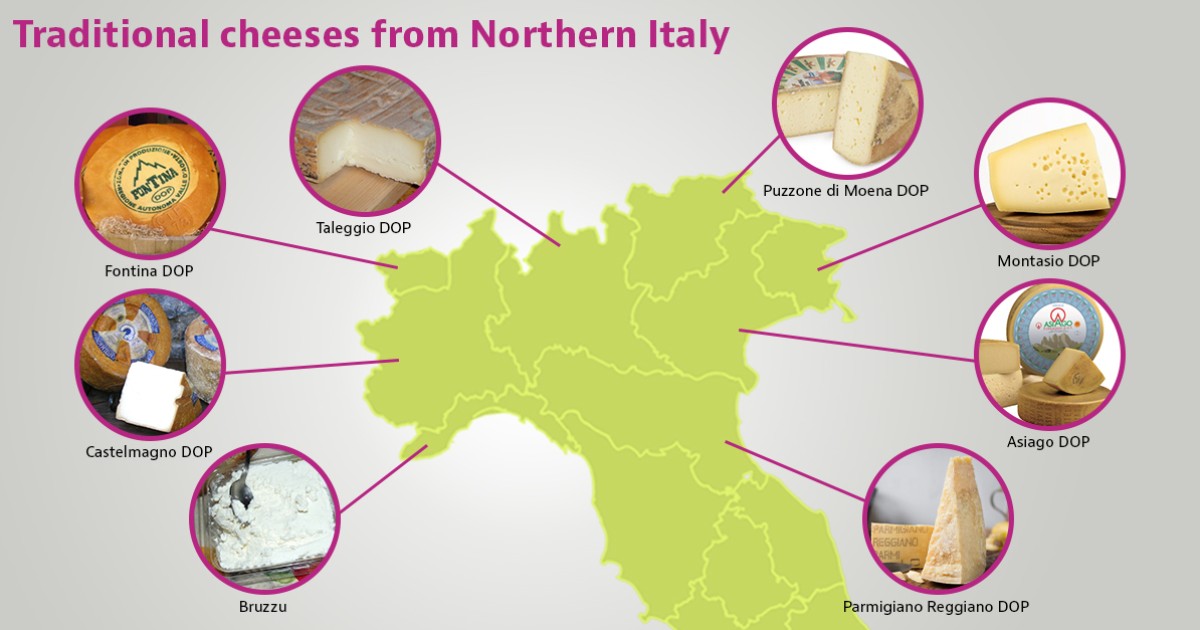

Every region in Northern Italy has its own cheese emblem: Fontina in Valle d’Aosta, Castelmagno in Piedmont, Bruzzu in Liguria, Taleggio in Lombardy, Asiago in Veneto, Puzzone di Moena in Trentino, Montasio in Friuli-Venezia Giulia and Parmigiano Reggiano in Emilia-Romagna.
Nearly all are protected by the DOP (Denominazione di Origine Protetta, or Protected Designation of Origin) label. These are the traditional cheeses of Northern Italy worth getting to know and trying.
Fontina DOP
Fontina DOP is Valle d’Aosta’s signature cheese: a semi-cooked cheese made solely with whole, raw cow’s milk from a single milking. There is no pasteurisation and no mixing of milk from different milkings. This is precisely what gives it its unmistakable aroma.
The product specification requires milk from Valdostana cows, including Red Pied, Black Pied and Chestnut varieties. These hardy animals are well adapted to mountain life. The wheels generally weigh between 7.5 and 12 kg and mature for at least 80 days in cool, humid settings, often rock-cut caves. They are regularly turned, salted and brushed by hand.
The dish that made it widely recognised is Valdostana fonduta, made with Fontina, milk, egg yolks and butter. It also works particularly well in polenta concia, a buttery cheese polenta, in Valdostana-style crêpes or simply on a slice of dark bread.
Castelmagno DOP
Crumbly, salty and marked by veins that develop naturally as it matures, Castelmagno DOP is one of Piedmont’s oldest and rarest traditional cheeses. It comes from Valle Grana, in the province of Cuneo, and may only be made in three comuni, or municipalities: Castelmagno, Pradleves and Monterosso Grana.
The milk is mainly cow’s milk, although the official specification allows a small proportion of sheep’s or goat’s milk. It must mature for at least 60 days, although the most prized Castelmagno is aged for much longer. Over time, its greenish-blue mould veining develops naturally, while the flavour becomes sharper and more lingering.
In the kitchen, Castelmagno gnocchi are a true Piedmontese classic. The cheese also crumbles well over risotto, polenta and pear-and-walnut salads.
Bruzzu
Among Northern Italian cheeses, Bruzzu is perhaps the least familiar and the most surprising. It does not have DOP status, but is recognised as a Ligurian PAT (Prodotto Agroalimentare Tradizionale, or Traditional Agri-food Product). It comes from the inland area of Imperia, in the valleys of the Ligurian Alps, close to the Piedmontese and French borders.
It is a fermented ricotta. This traditional Ligurian cheese is made with ricotta from the Brigasca sheep, a native breed raised by local shepherds for centuries. In Liguria, it is spread on homemade bread or focaccia, perhaps with a drizzle of Riviera extra-virgin olive oil. When diluted, it becomes an unusual dressing for fresh pasta or boiled vegetables.
Taleggio DOP
With its pinkish rind, square shape and soft paste that melts in the mouth, Taleggio DOP is Italy’s best-known washed-rind cheese and one of Lombardy’s traditional cheeses. It takes its name from Val Taleggio in the Bergamo valleys, where production was already documented in the Middle Ages.
Taleggio’s secret lies in the way it is cared for. During maturation, which lasts at least 35 days, the cheeses are periodically washed with a sponge soaked in water and salt. This encourages the formation of its thin, soft rind and characteristic moulds.
In cooking, it is particularly good melted into risotto, over polenta taragna or in savoury tarts. Served uncooked, it goes well with pears, walnuts or mostarda, a sweet and mustardy fruit preserve. A red Valcalepio or Franciacorta sparkling wine are both well-suited pairings.
Asiago DOP
Asiago DOP comes in two types: Asiago Fresco, also called Pressato, and Asiago Stagionato, traditionally called d’Allevo. Both originated on the Asiago Plateau in Veneto, although the production area now also extends into the province of Trento and parts of the provinces of Padua and Treviso.
Asiago Fresco is made with whole cow’s milk and matures for at least 20 days. It has a soft, white paste with pronounced, irregular eyes, or holes. Its flavour is delicate and milky, with a slight tang. Asiago Stagionato, meanwhile, is made with partially skimmed milk and goes through a longer ageing process.
The aged version works particularly well with a full-bodied red such as Valpolicella Superiore or Amarone, perhaps accompanied by honey or preserves. In the kitchen, it adds flavour to gnocchi, risotto and Veneto’s version of the well-known frico.
Puzzone di Moena DOP
Puzzone di Moena DOP is a Trentino cheese with a strong smell and a surprisingly harmonious flavour. In Ladin, it is called Spretz Tzaorì, meaning “tasty cheese”.
It is made between Val di Fassa and Val di Fiemme, with a production area that now includes other mountain areas of Trentino. It received DOP status in 2014, following decades of traditional production in mountain farmsteads and valley dairies.
Puzzone is particularly well suited to melting: in canederli bread dumplings, over polenta, in tortel di patate potato fritters or in a mountain-style toastie. Served as it is, it calls for a local red such as Teroldego Rotaliano or Marzemino.
Montasio DOP
When talking about Friuli-Venezia Giulia, it is hard not to think of Montasio DOP and its most iconic dish, frico. This cooked-curd cheese takes its name from the Montasio plateau in the Julian Alps, where its production was already linked to the monks of Moggio Abbey in the 13th century. Montasio changes considerably depending on its age:
- Fresco (at least 60 days): soft, elastic paste with a sweet, delicate flavour;
- Mezzano (4 to 10 months): a rounder, more fragrant taste;
- Stagionato (more than 10 months): an intense flavour and crumbly texture;
- Stravecchio (more than 18 months): full-flavoured and slightly spicy, particularly suitable for grating.
Frico is the region’s signature recipe: Montasio melted in a frying pan, often with potatoes and onion, until it forms a golden, crisp sort of omelette. There is also a crunchy version, thin as a wafer.
Parmigiano Reggiano DOP
Parmigiano Reggiano DOP is a hard, cooked-curd cheese made with just three ingredients: raw milk, salt and rennet. The production area for this traditional cheese from Emilia-Romagna includes the provinces of Parma, Reggio Emilia and Modena, along with part of Bologna province, to the left of the River Reno, and part of Mantua province, to the right of the River Po.
Each wheel weighs around 40 kg and requires more than 500 litres of milk. The minimum maturation period is 12 months, the longest required for any Italian DOP cheese. At that point, each wheel is inspected by experts from the Consortium, who tap it with a small hammer to listen to its sound and identify any internal defects. The taste changes considerably with age:
- 12–18 months: delicate, with notes of milk and yoghurt;
- 24 months: balanced, the most classic maturation period;
- 30–36 months and beyond: intense and spicy, with the characteristic crunchy tyrosine crystals.
Few people realise that Parmigiano Reggiano is naturally lactose-free. During its long maturation process, the lactose disappears. This is why it is often recommended for people with lactose intolerance.
Stay inspired for your adventures in Italy —get our weekly newsletter for the latest travel, legal, and lifestyle news.
Source: https://www.idealista.it/